9 Best Insider Trading Websites for 2027
Every insider trading website lists the latest Form 4 filings. Which one tells you what each trade actually was?


Company officers, directors and holders of more than 10% of a company's shares must report changes in their holdings to the SEC on Form 4 within 2 business days. Insider trading websites collect those filings and show them by company, by insider or as a market-wide feed.
Below are 9 insider trading websites for following Form 4 filings. We compare them on transaction codes, history, insider holdings, 13F owners, export, API access and price.
Why most Form 4 rows are not trades
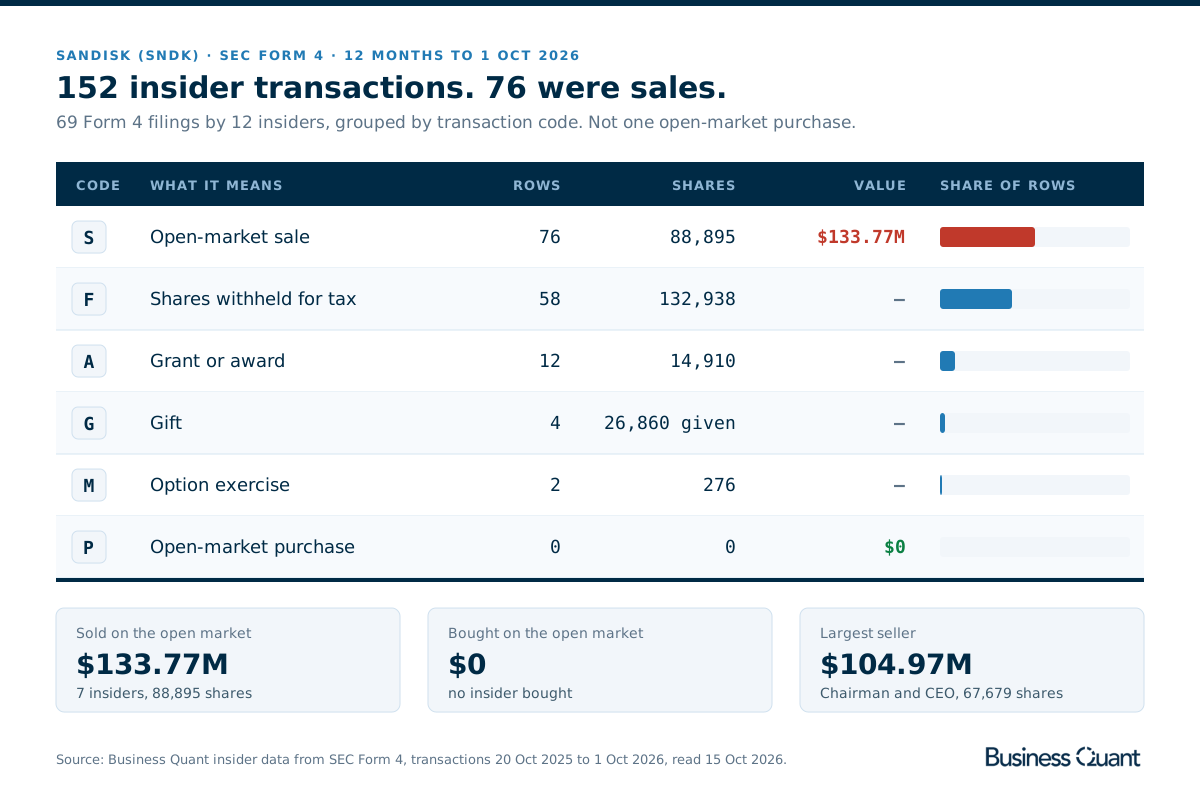
A Form 4 reports every change in an insider's holding, and most of those changes are not decisions to buy or sell. Over the 12 months to 1 October 2026, Sandisk's insiders filed 69 Form 4s containing 152 transactions. 76 were open-market sales. 58 were shares withheld to pay tax on vesting stock, 12 were grants, 4 were gifts and 2 were lines from one option exercise. There was not one open-market purchase.
Each row carries a code that says which kind of change it was: S for an open-market sale, P for a purchase, F for tax withholding, A for a grant, G for a gift and M for an option exercise. A site that files tax withholding under "sell" reports 134 sales where there were 76, and one that files grants under "buy" shows buying that never happened.
History is the second test. Grants vest on fixed dates and executives often sell under pre-arranged plans, so a quarter of selling means little until you can set it against the same quarter in earlier years.
How to choose an insider trading website
- The transaction code. Whether a row says sale, grant, tax withholding or gift, or only bought and sold.
- History. How many years of a company's insider trades you can read.
- Holdings. Whether you can see what each insider owns now, not just what they traded.
- Context. Whether institutional owners and the company's financials sit next to the trades.
If you want insider data in your own code, our insider trading API comparison covers the developer side.
The 9 insider trading websites at a glance
- Finviz
- InsiderFinance
- InsiderScreener
- InsiderTracking
- OpenInsider
- Quiver Quantitative
- SEC EDGAR
- SecForm4
- Business Quant
| Platform | Best for | Plans from |
|---|---|---|
| Finviz | Insider trades beside a fast quote page | $24.96/mo |
| InsiderFinance | Traders who also follow options flow | $55/mo |
| InsiderScreener | Insider buying across 17 markets | $10.75/mo |
| InsiderTracking | US and Canadian insider sentiment | $17.79/mo |
| OpenInsider | Screening every Form 4 at no cost | $0 |
| Quiver Quantitative | Open-market trades next to alternative data | See note |
| SEC EDGAR | The official record, filing by filing | $0 |
| SecForm4 | Insider, 13D/G and 13F filings in one place | $44.95/mo |
| Business Quant | Insider trades beside holdings, 13F owners and financials, with export and API access | $29/mo |
Rows are alphabetical, Business Quant last. "Plans from" is the cheapest paid plan's lowest advertised monthly price on 15 October 2026; $0 means the site has no paid plan, and Quiver Quantitative shows its Premium prices only after you create an account.
Insider trading websites reviewed
Finviz
Finviz shows insider trades on every stock's quote page, and its Insider page adds a feed of new filings, the week's largest insider trades and the week's 10% owner trades.
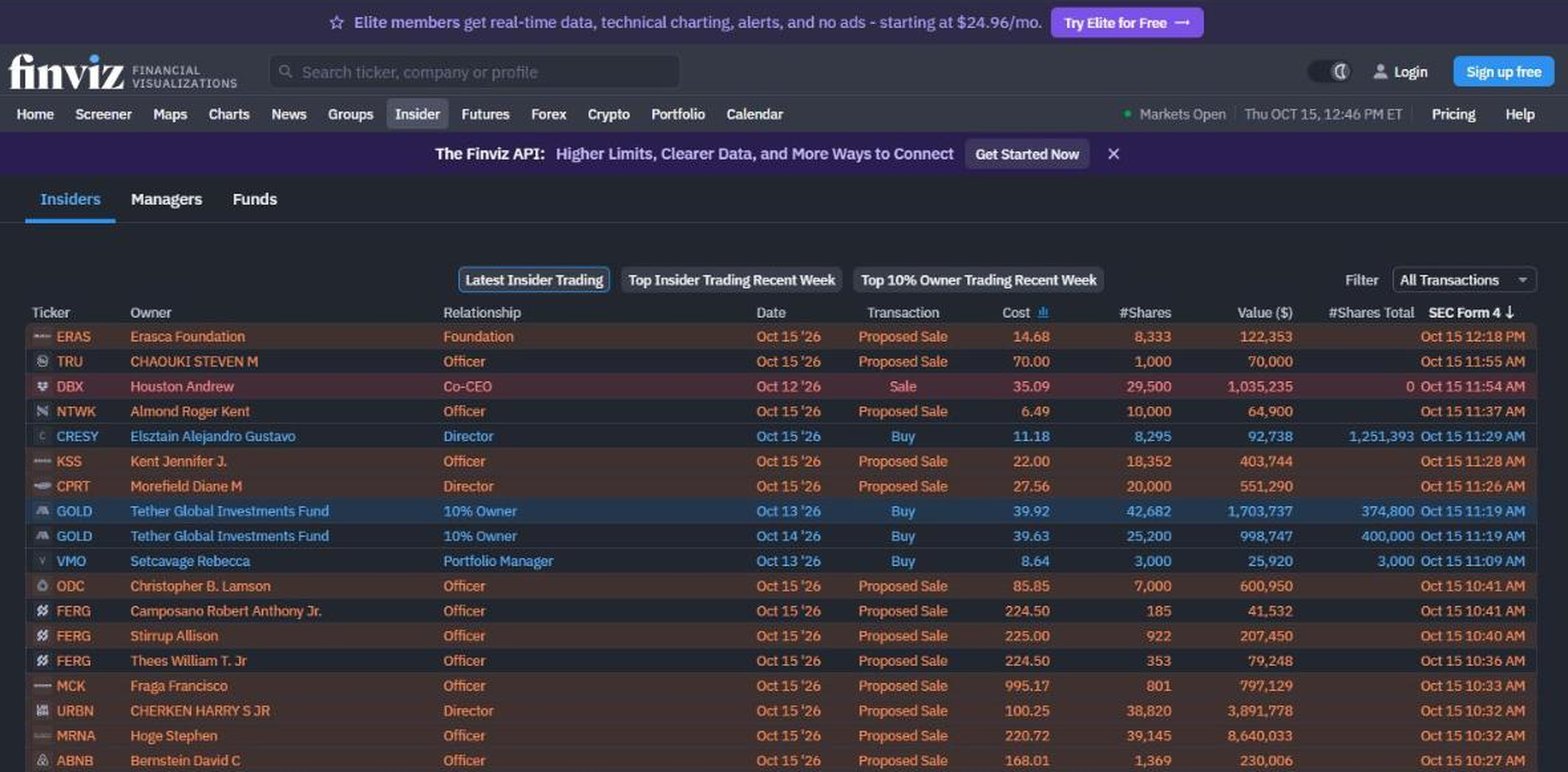
- Best for insider trades beside a fast quote page.
- Insider page at $0: latest trades, top weekly trades and 10% owners, filtered by buy or sale.
- Labels: Buy, Sale, Option Exercise and Proposed Sale.
- Top institutional holders and statements on each quote page.
- Elite from $24.96 a month, with real-time data and alerts.
The strength is placement. On a stock's quote page the insider table sits below the financial statements and the list of top institutional managers and funds, so you can glance at insider selling while you are already looking at the company. Proposed sales, filed on Form 144 before a sale happens, appear in the same list and hint at selling to come.
Where it falls short: the labels are broad. Sandisk's quote page showed sales, proposed sales and an option exercise, but none of the grants or tax withholdings that the SEC records for the same months, and the table covered roughly the last year. There is no insider holdings table.
InsiderFinance
InsiderFinance is an options-flow platform for active traders that also runs a free insider trades tracker, open without an account.
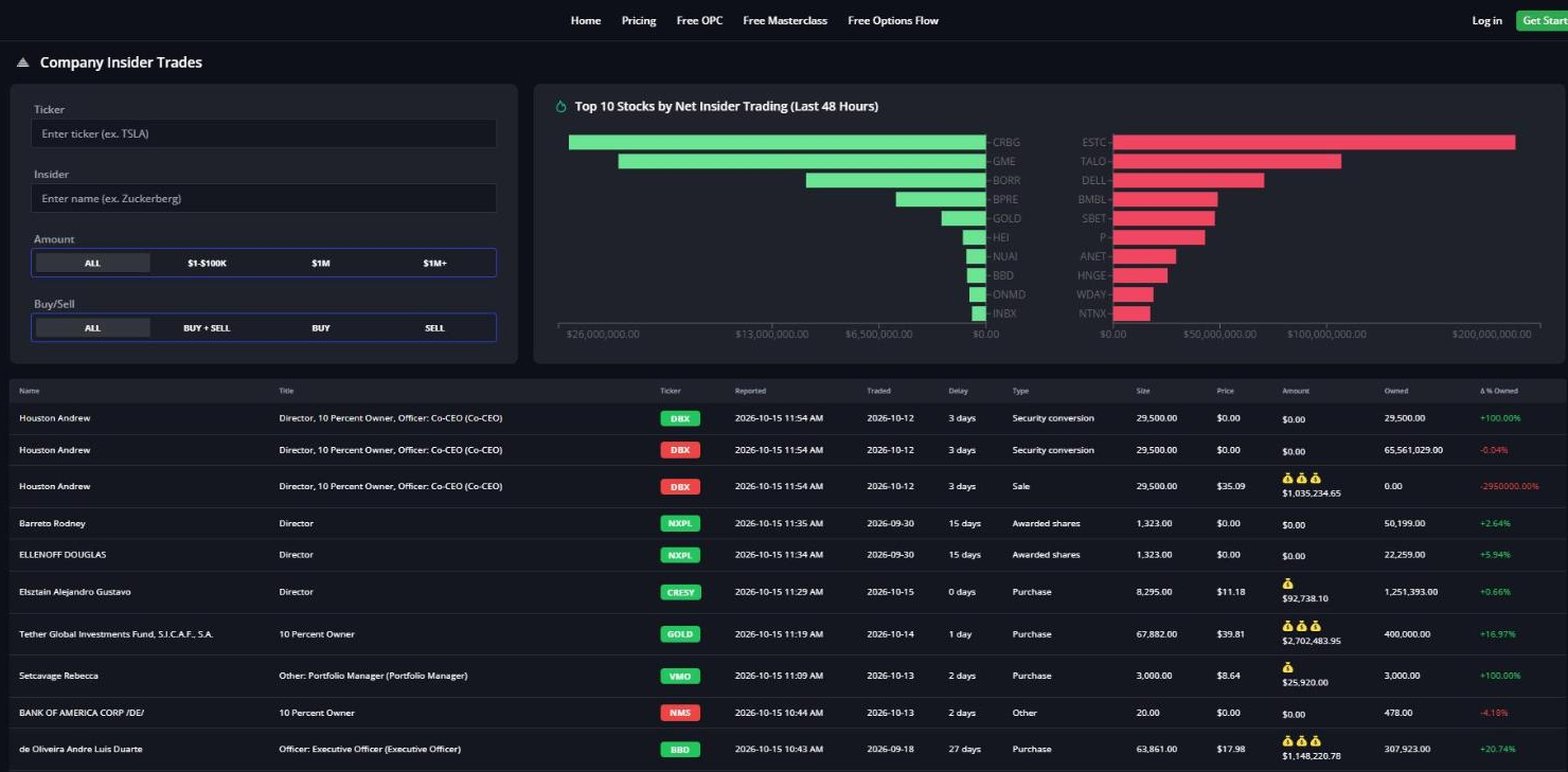
- Best for traders who also follow options flow.
- Insider tracker at $0, with ticker, insider and size filters.
- Top 10 stocks by net insider buying and selling over 48 hours.
- Delay in days between each trade and its filing.
- Plans from $55 a month billed yearly, or $75 monthly.
The Delay column is a useful touch: a purchase filed on the day reads differently from one filed weeks after the trade. Types are shown in words, such as purchase, sale, awarded shares and security conversion.
Where it falls short: some rows are labelled other or unknown rather than by code, and the paid plans are sold for options order flow, dark pool prints and trade ideas, not insider data. We found no holdings table, 13F owners or export for insider trades.
InsiderScreener
InsiderScreener covers insider filings in 17 markets: the United States and Canada, 12 European countries, India, and Australia and South Korea in beta. Its US data starts on 30 June 2003.
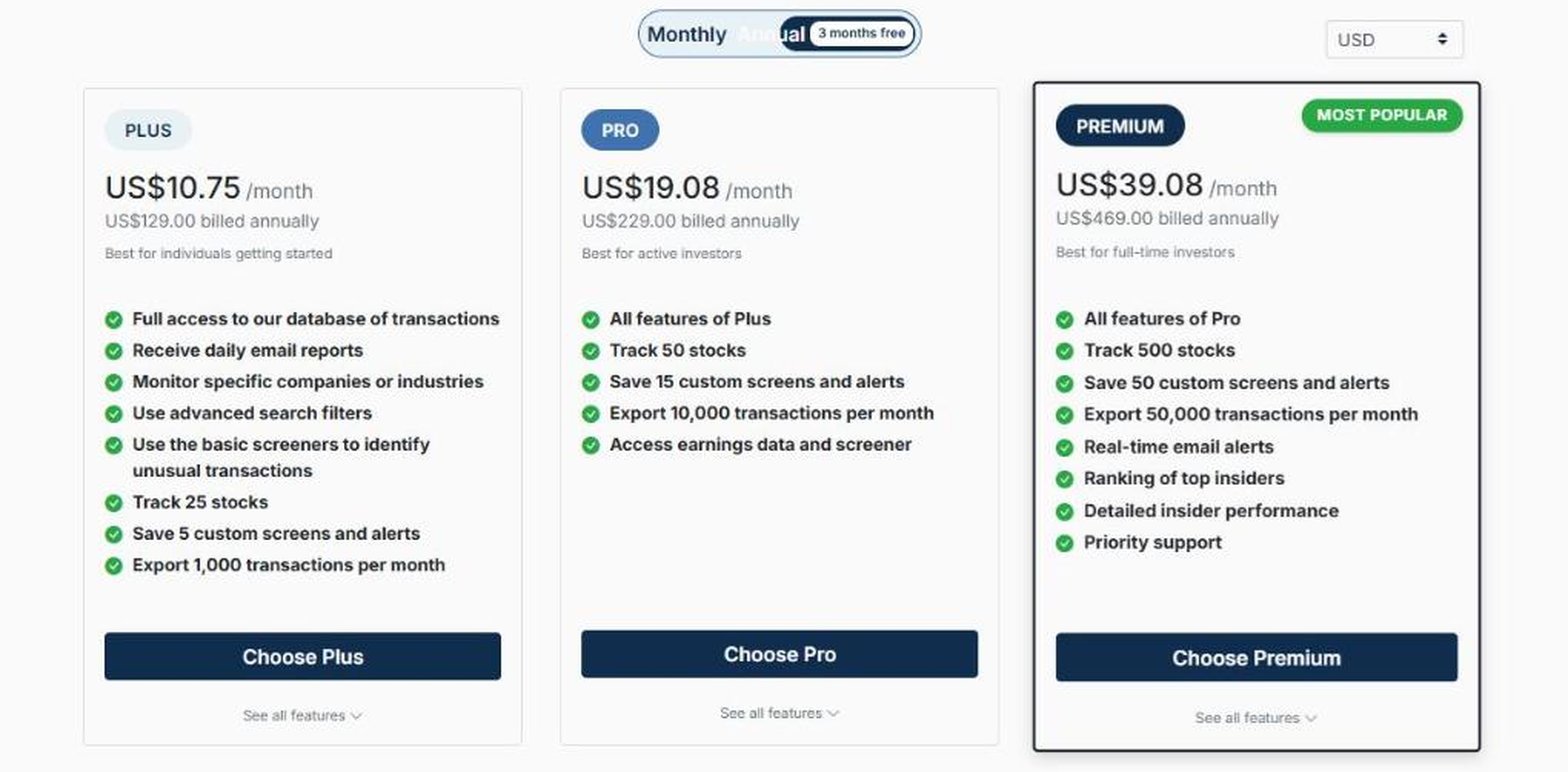
- Best for insider buying across 17 markets.
- Search of recent filings at $0.
- Plus from $10.75 a month, or $17 monthly: full database, daily emails, 25 tracked stocks and 1,000 exports a month.
- Screeners for cluster buys, buying the dip and top executive buys.
- Premium from $39.08 a month, with real-time alerts and insider performance.
If you follow companies in Europe or India as well as the US, nothing else here covers them. The screeners are built around insider buying, which is the signal most investors come looking for.
Where it falls short: transactions are grouped into buy, sell, planned and proposed trades and a combined "option / other" bucket, so grants and tax withholdings are not separated. Most filters and the full history need a subscription, and there is no free trial, only a 14-day money-back guarantee.
InsiderTracking
InsiderTracking is run by INK Research. It covers SEC Forms 3, 4 and 5 alongside Canada's SEDI filings, and builds an insider sentiment indicator from both.
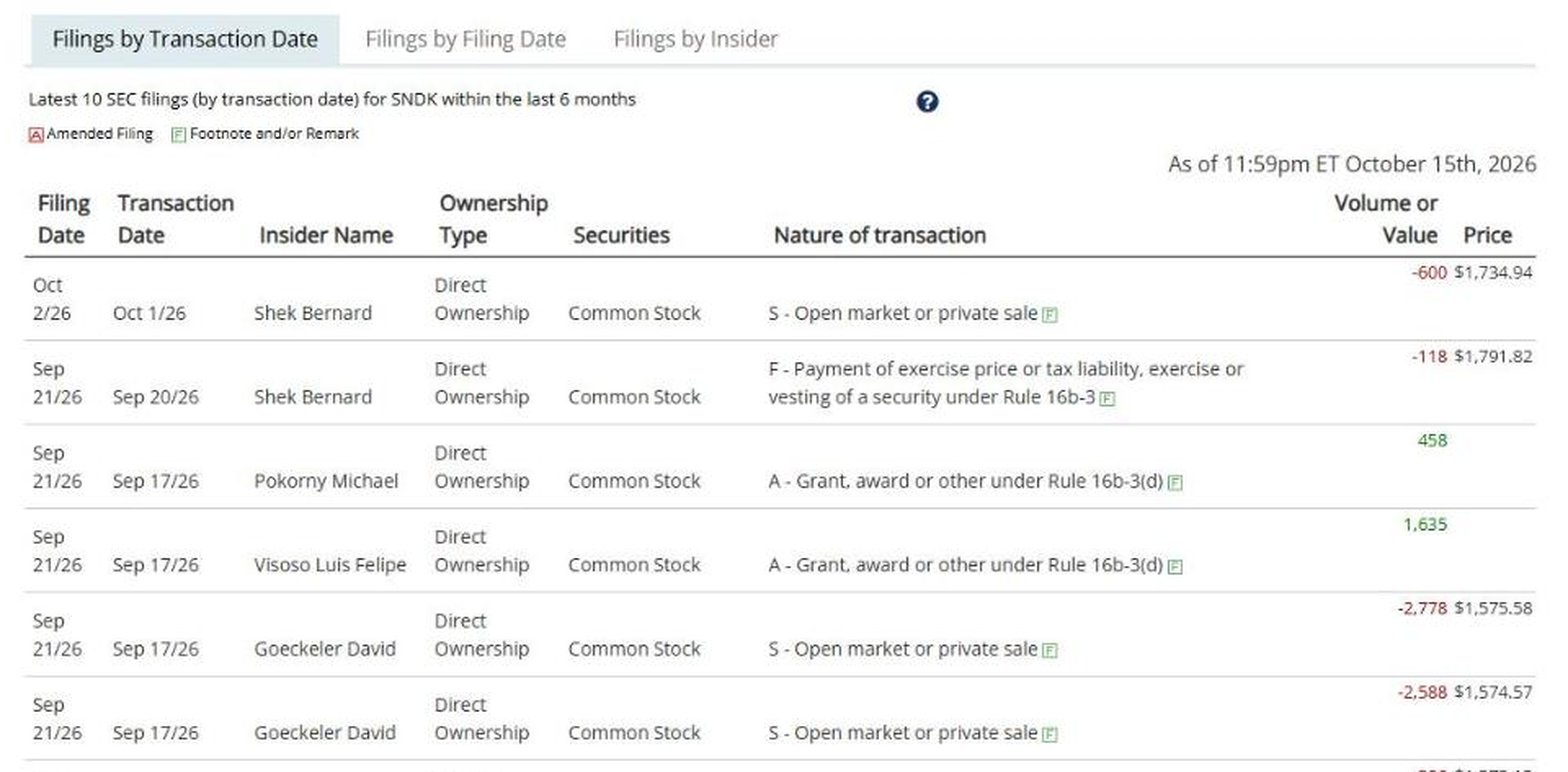
- Best for US and Canadian insider sentiment.
- Top filers by net buying and selling over the past 7 days.
- INK indicators of insider sentiment against the S&P 500 and the TSX.
- Company pages with the latest 10 filings from the past 6 months.
- Advantage Ultra from $17.79 a month plus tax, with alerts on up to 200 stocks and weekly reports.
The company pages are clear about what each trade was. Every row carries the full description of its code, so a tax withholding reads as a tax withholding, and the price sits beside it.
Where it falls short: the record is short by design. Even the paid plan carries up to 6 months of filing history, because the product is about current sentiment, and there is no holdings table or 13F data.
OpenInsider
OpenInsider is a Form 4 screener with no paid plan: pick the transaction types, insider titles, industries and trade sizes you care about, and it lists every match. It was the top Google result for this search on 15 October 2026.
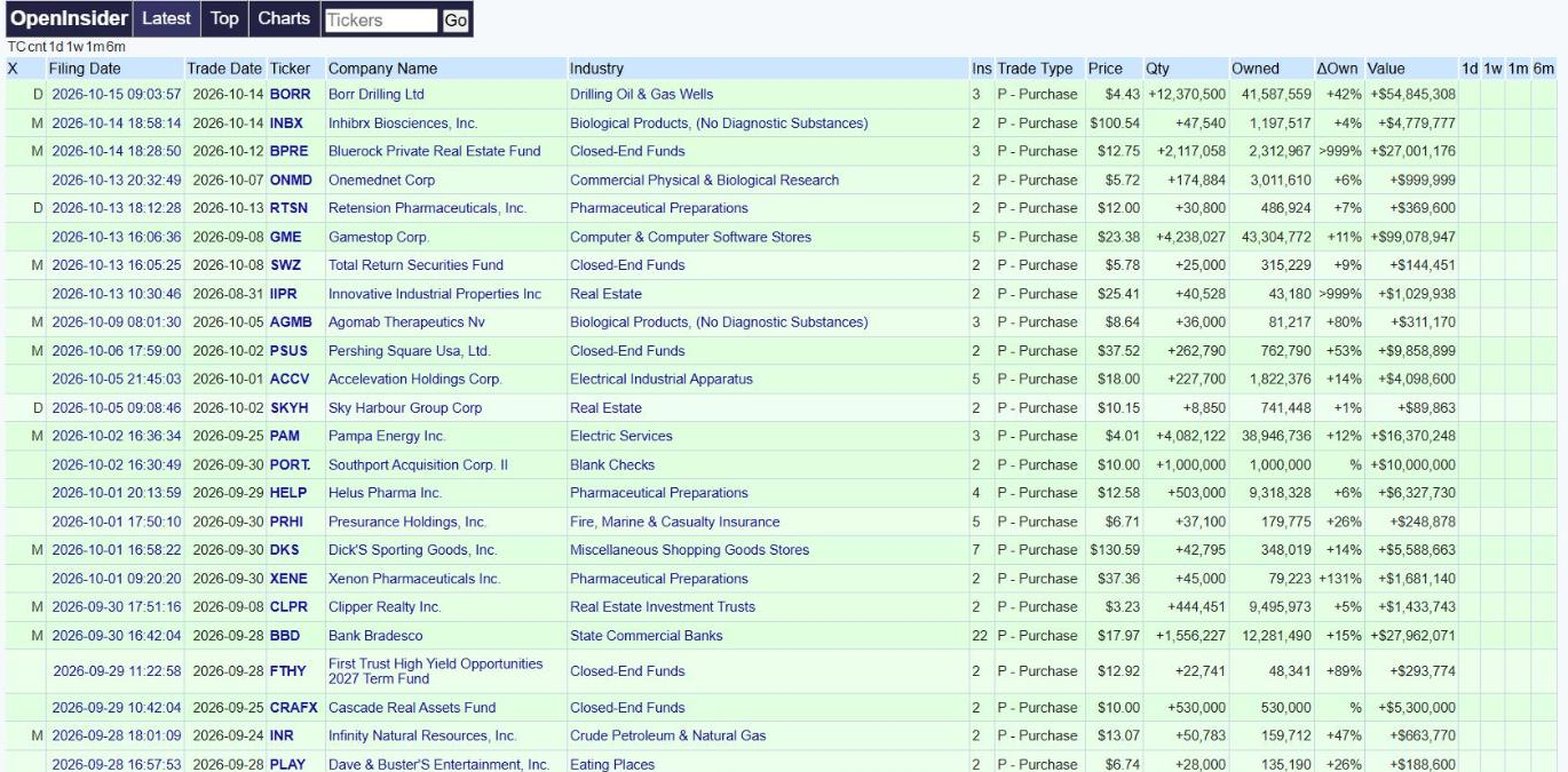
- Best for screening every Form 4 at no cost.
- 10 transaction codes to filter, from purchase and sale to gift and tax.
- Ready-made lists: cluster buys, latest buys, penny stocks and sales over $100,000.
- Price change after 1 day, 1 week, 1 month and 6 months.
- Records back to 2003; Apple's start in September 2003.
For finding trades across the whole market, OpenInsider is the benchmark. The cluster buys list answers the question most people bring to an insider site, and the code filters let you exclude grants and tax withholdings with 2 clicks.
Where it falls short: it is a screener and nothing else, with no holdings tables, institutional owners, financials or export. Some visits show a prompt to watch a short ad in exchange for 24 hours of access.
Quiver Quantitative
Quiver Quantitative is an alternative data platform that puts insider trades next to datasets few other sites carry, such as congressional trading. Its Insider Trading Dashboard is free to browse.
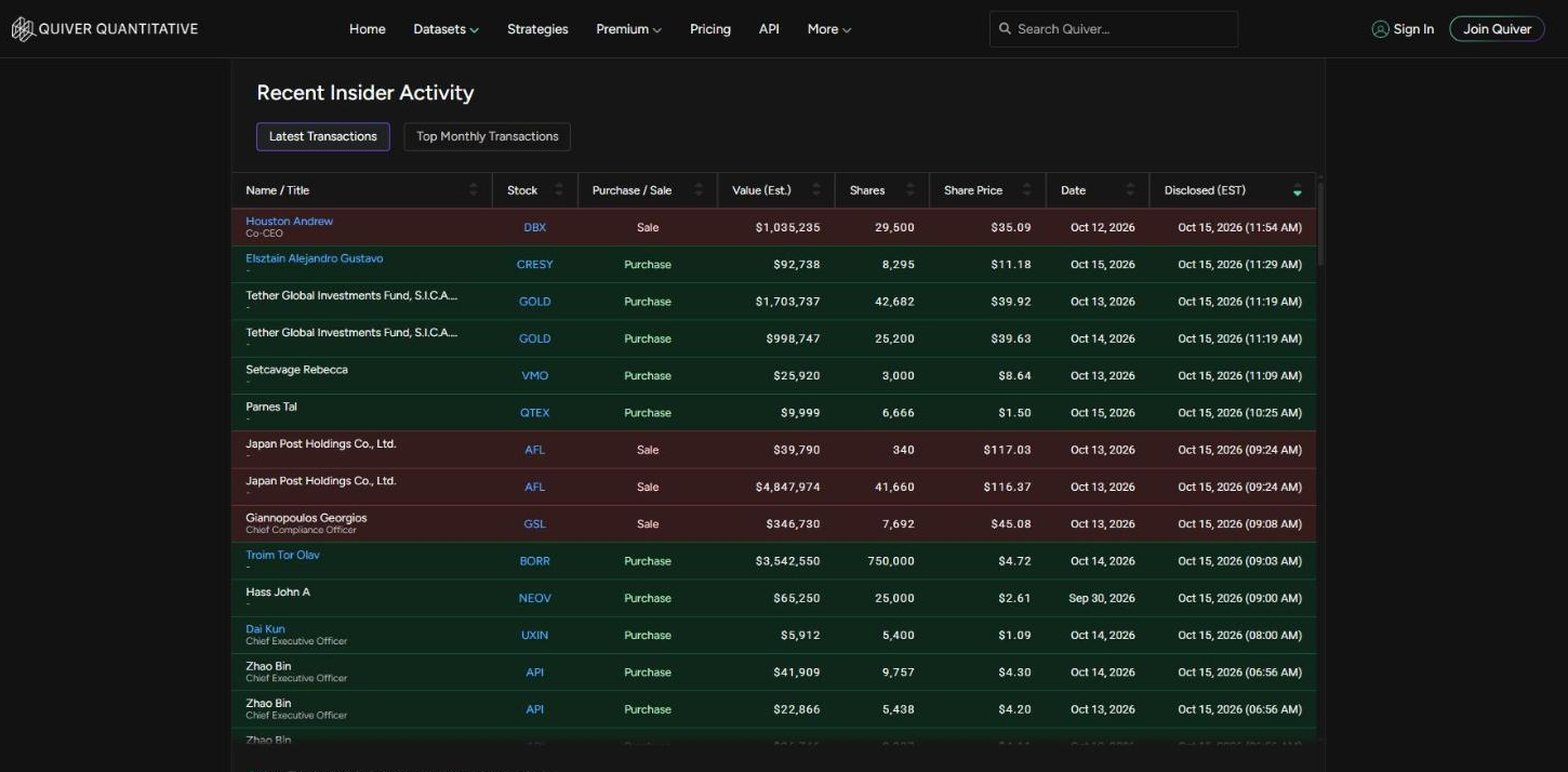
- Best for open-market trades next to alternative data.
- Dashboard at $0: largest recent trades, executive buys, and latest and top monthly transactions.
- Stock pages with insider trades and institutional holders.
- Insider alerts with Quiver Premium, priced after you create an account.
Quiver filters out everything except open-market purchases and sales, and says so on the page. That makes the dashboard quick to read: what you see is money moving, with no grants or withholdings to skip past.
Where it falls short: you cannot see the rest of an insider's Form 4 activity, so grants, tax withholdings and gifts are missing by design. Premium prices are hidden until you sign up, and we found no holdings table or export.
SEC EDGAR
SEC EDGAR is the source every other site reads. Its ownership view for a company lists everyone who has filed as an insider, with their role, and every reported transaction with its code, filing by filing.
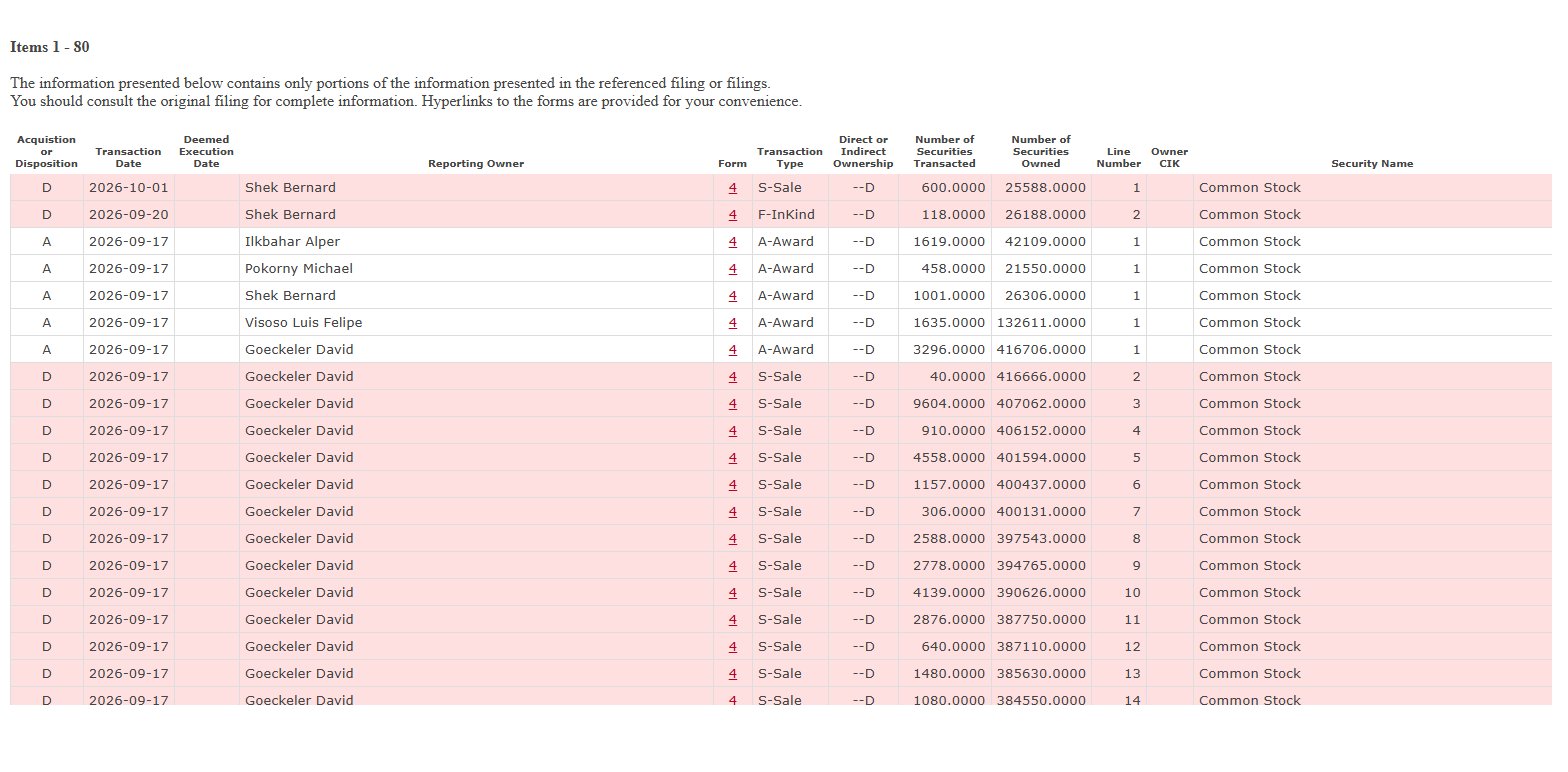
- Best for the official record, filing by filing.
- No cost, published by the SEC, with free data APIs.
- Every transaction code, such as S-Sale, F-InKind and A-Award.
- Shares transacted and shares owned after each line.
- History to 2003, when Form 4 filing went electronic.
When 2 websites disagree about a trade, EDGAR settles it. Nothing is reclassified or summarised, and every line links back to the filing it came from.
Where it falls short: the ownership view is a ledger, not a tool. It has no price column, so the price means opening the filing, and there are no charts, screens, holdings summaries or alerts.
SecForm4
SecForm4 is an ownership filings site that covers insider trades, 13D and 13G stakes and 13F holdings, organised by company and by filer.
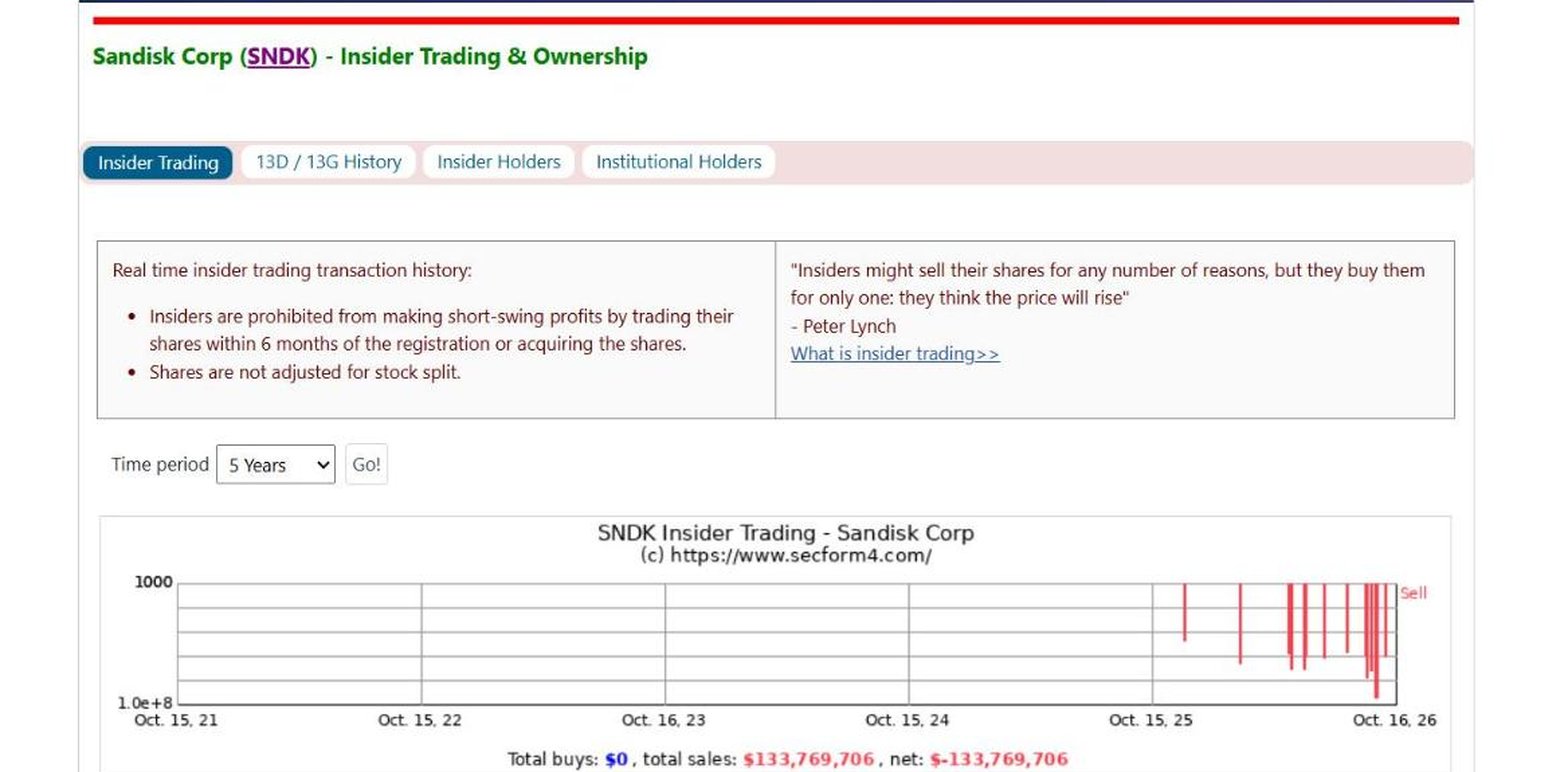
- Best for insider, 13D/G and 13F filings in one place.
- Company pages at $0, with time periods up to all data.
- Separate tables for purchases and sales, and for awards, exercises, tax and gifts.
- Insider Holders and Institutional Holders tabs.
- Insider Advanced from $44.95 a month, with a 7-day trial, real-time filing views and email alerts.
Splitting each company's activity into 2 tables, open-market trades in one and awards, exercises, tax withholdings and gifts in the other, stops the noise drowning out the trades. The Sandisk chart totals the period's buying and selling in one line: $0 bought and $133.8 million sold.
Where it falls short: share counts are not adjusted for stock splits, which the site states on each page, so long histories across a split need care. The insider screener, buy and sell ratios and CSV downloads sit on Insider Pro, at $49.95 a month.
Business Quant
Business Quant is ours. Every stock page carries an Insider Ownership tab built from Form 4, next to institutional ownership from 13F, the SEC filings list and the company's financial statements. The Sandisk insider page shows what that looks like.
- Best for insider trades beside holdings, 13F owners and financials, with export and API access.
- Free to use, with the full insider record, no card.
- Pro from $29 a month, full history, export and API access.
List of features
- Insider transactions: every Form 4 code, price, value and shares held after
- A written summary of 12 months of open-market buying and selling
- Insider ownership statistics, direct and indirect, with the quarterly change
- Charts of shares owned and shares bought and sold, over 5 years, 10 years or max
- Form 4 holdings: each insider's direct, indirect and total position
- Institutional ownership from 13F
- 18 million+ SEC filings since 1993
- Financial statements, segment financials and KPI data
- Analyst estimates
- Stock screener with more than 700 metrics
- Economic data
- CSV and XLSX download
- Insider transactions API
- MCP server
The transaction table keeps every Form 4 code: open-market sales (S), grants (A), tax withholdings (F), gifts (G) and exercises (M) each appear as what they are, with direct or indirect ownership marked. Above it, the summary does the sorting in plain sentences. For Sandisk it reads that insiders sold $133.77 million of stock on the open market over the past year and bought none, that 7 insiders were behind the sales, that the largest seller sold $104.97 million, and how many shares moved through awards, exercises, tax withholding and gifts.
The history is long enough to compare years: Apple's Insider Ownership tab holds 3,900 transactions going back to January 2007, and Nvidia's holds 4,677. The rest of the stock page answers the questions an insider sale raises, with the institutional ownership tab on about 4,700 stocks, the company's filings, and statements that show whether the business is growing while insiders sell.
Insider trading websites feature by feature
| Platform | Every Form 4 code |
10+ years of history |
Insider holdings |
13F holders by stock |
Spreadsheet export |
API access |
MCP server |
Plans from |
|---|---|---|---|---|---|---|---|---|
| Business Quant | ✓ | ✓ | ✓ | ✓ | ✓ | ✓ | ✓ | $29/mo |
| SecForm4 | ✓ | ✓ | ✓ | ✓ | ✓ | ✗ | ✗ | $44.95/mo |
| SEC EDGAR | ✓ | ✓ | ✗ | ✗ | ✗ | ✓ | ✗ | $0 |
| InsiderScreener | ✗ | ✓ | ✗ | ✗ | ✓ | ✗ | ✗ | $10.75/mo |
| OpenInsider | ✓ | ✓ | ✗ | ✗ | ✗ | ✗ | ✗ | $0 |
| Finviz | ✗ | ✗ | ✗ | ✓ | ✗ | ✗ | ✗ | $24.96/mo |
| InsiderTracking | ✓ | ✗ | ✗ | ✗ | ✗ | ✗ | ✗ | $17.79/mo |
| Quiver Quantitative | ✗ | ✗ | ✗ | ✓ | ✗ | ✗ | ✗ | See note |
| InsiderFinance | ✗ | ✗ | ✗ | ✗ | ✗ | ✗ | ✗ | $55/mo |
Sorted by ticks, ties broken alphabetically. A tick means the platform's own pricing, plan, help or company pages document the feature on a self-serve plan, or its stock pages showed it when we tested them; a cross means we found no such documentation. "Every Form 4 code" means each transaction carries its code or that code's specific meaning (sale, grant, tax withholding, gift, exercise), not a buy, sell or other bucket. "10+ years of history" means a company's insider history of 10 years or more can be read. "Insider holdings" means a table of what each insider owns now. "13F holders by stock" means a list of a company's institutional holders. "Spreadsheet export" means downloading insider data to a file. "API access" and "MCP server" mean a self-serve API and an AI-assistant connector.
Business Quant is the only site here that ticks every column. SecForm4 comes closest with 5, missing only an API and an MCP server, and SEC EDGAR reaches 3 with every code, the full record and free data APIs. InsiderScreener is built for buying signals across 17 markets and InsiderFinance for traders who live in options flow, Quiver Quantitative leaves out non-market transactions on purpose, and InsiderTracking keeps a short record because its product is current sentiment. A cross shows what a product was built for, not how good it is.
Which insider trading website is right for you?
- You want insider trades on the quote page you already use: Finviz.
- You trade options flow and want insider trades beside it: InsiderFinance.
- You follow insider buying in Europe, India or Canada: InsiderScreener.
- You want a weekly read of insider sentiment: InsiderTracking.
- You want to screen the whole market for cluster buys at no cost: OpenInsider.
- You only care about open-market buying and selling: Quiver Quantitative.
- You need the official record to settle a disagreement: SEC EDGAR.
- You want insider, 13D/G and 13F filings by company: SecForm4.
- You want every Form 4 code beside holdings, 13F owners and the financials, with export and an API: Business Quant.
Our hedge fund tracker comparison covers what funds hold, and our institutional ownership API comparison covers 13F data in code. For working with filings directly, start with the SEC filings guides.
Where I would check insider trades first
Market-wide feeds are good at telling you that someone sold. For reading whether it mattered, I would start on the Business Quant Insider Ownership tab for that stock.
Business Quant keeps every Form 4 code, so the Sandisk record reads as 76 open-market sales, 58 tax withholdings and no purchases, not 134 sales. The written summary puts the year's open-market buying and selling in one paragraph, and the holdings table shows what each insider still owns after the sale.
The history runs long, to 2007 for Apple, so this year's selling can be set against earlier years, and insider holdings, 13F owners and the financial statements sit on the same stock page. It is free to use, and Pro, with full history, export and API access, is from $29 a month.
A 5-minute test: pick a stock you own and open its insider record on 2 or 3 sites. Count the sales each one shows for the past 12 months, then count how many of those were really tax withholdings or grants. The site whose count matches the Form 4 codes is the one to keep.
How this comparison was made
To make the list, a website had to let an individual look up insider transactions reported on SEC Form 4 for US-listed companies, showing the insider, their role, the date, the shares and the transaction type, at no cost or at a price published on the vendor's own site. Congressional trading trackers, mobile-only apps, newsletters and developer APIs without a lookup website were not included. 9 websites met that bar.
Every price, plan limit and feature was read on the vendor's own pricing, plan, help or company pages on 15 October 2026 and screenshotted there, and InsiderScreener's screeners and markets were checked again on 16 October. Prices are each platform's lowest advertised monthly price in US dollars on 15 October 2026. Transaction codes, history and holdings were checked on each site's page for Sandisk where one exists, and the figures in our illustration come from our insider data for Sandisk, read on the same day.
The list, the summary table and the reviews run alphabetically, with Business Quant last, and the feature table is sorted by the number of ticks, with ties broken alphabetically. We make Business Quant, one of the 9 products compared here.
Image credits. Header photograph by Scott Graham on Unsplash, used under the Unsplash License. Vendor screenshots were captured on 15 October 2026 from each provider's own pricing, insider or company pages and are reproduced for comparison. The Sandisk illustration is our own, built from our insider data.
Frequently asked questions
Is there a free website that tracks insider trades?
Yes, several. Business Quant is free to use and shows every Form 4 transaction for a stock with its code, price, value and shares held after, alongside insider holdings and 13F owners. SEC EDGAR, OpenInsider and SecForm4 also let you browse insider trades at no cost, and Finviz, Quiver Quantitative, InsiderTracking and InsiderFinance each have a free insider page. InsiderScreener lets you search recent filings for free and sells its full database from $10.75 a month.
Is insider trading legal?
Buying and selling your own company's stock is legal for officers, directors and 10% owners, provided they report it. They file Form 4 with the SEC within 2 business days of the trade, and those filings are what every site in this list reads. Trading on material information the public does not have is illegal, and it is not what these websites track.
How quickly are insider trades made public?
An insider has 2 business days after the trade to file Form 4, and the filing is public on EDGAR as soon as the SEC accepts it. Websites then pick it up on their own schedule: SecForm4 sells real-time filing views on its paid plans, InsiderScreener describes its US feed as near real time, and InsiderFinance shows the delay in days between each trade and its filing.
Which insider transactions matter most?
Open-market purchases, code P, because an insider spent their own money at the market price. Most Form 4 rows are something else: grants (A), shares withheld for tax (F), option exercises (M) and gifts (G). At Sandisk, 152 Form 4 rows over 12 months included 76 open-market sales, 58 tax withholdings and no purchases at all, which is why a site that shows the code is worth more than one that only says bought or sold.
What is insider cluster buying?
Several insiders at the same company buying on the open market within a short window. One purchase can be personal; 3 directors buying in the same week is harder to explain away. OpenInsider publishes a Latest Cluster Buys list, and InsiderScreener includes cluster buys among the screeners on its paid plans.
Do insider trading websites track members of Congress?
Congressional trades are a different disclosure, filed under the STOCK Act rather than on Form 4, so most insider trading websites do not mix the two. Quiver Quantitative and InsiderFinance run separate Congress trading pages next to their insider trackers.