10 Best SEC Filings APIs
A filings API does 3 things: tell you a filing exists, hand you the files inside it, and hand you a section as clean text. 10 options compared on all 3 and on when the work gets done.


Start with the thing most comparisons bury, because it will save some of you a purchase: the official SEC EDGAR endpoints are free, complete and public. Every filing, every exhibit, back to the mid-1990s. No key, no invoice. If you are evaluating paid options without having hit a wall on the free one, you are shopping early.
When you do hit a wall, it is one of 3, and they are the 3 things these products sell. A real-time feed, when you need to know a filing landed now rather than tomorrow morning. Split documents, when you need one named exhibit out of a filing holding 40 files. Section extraction, when you need Item 1A as text and do not want to own a parser for the rest of your life. Almost nobody sells all 3.
The 3 things that matter
- SEC EDGAR
- EdgarTools
- Business Quant
- FinFeedAPI
- Quantillium
- sec-api.io
- SEC Filing Data
- Calcbench
- Financial Modeling Prep
- Intrinio
| Platform | Real-time feed |
Pre-split documents |
Pre-extracted narrative |
Price from |
|---|---|---|---|---|
| Business Quant | ✓ | ✓ | ✓ | $0 |
| EdgarTools | ✓ | ✓ | ✓ | $0 |
| sec-api.io | ✓ | ✗ | ✓ | $49 |
| SEC Filing Data | ✓ | ✗ | ✓ | $45 |
| FinFeedAPI | ✓ | ✗ | ✓ | $1/credit |
| Calcbench | ✓ | ✗ | ✓ | Add-on |
| SEC EDGAR | ✓ | ✓ | ✗ | $0 |
| Quantillium | ✗ | ✗ | ✓ | $99 |
| Financial Modeling Prep | ✓ | ✗ | ✗ | $19 |
| Intrinio | ✗ | ✗ | ✗ | $150 |
Ordered by ticks, then by published index breadth where 2 platforms tie. A tick means the capability is documented and available at the entry tier. A cross means it is absent from that platform's published documentation, or excluded at that tier, not that it is impossible to build. Prices are the lowest published monthly figure that includes filings access, and several carry eligibility or licence limits that the entries spell out.
One line about price before the detail, because the cheapest number is rarely the one you pay. EDGAR data is public domain and you may redistribute it. Most commercial platforms here sell the entry tier for internal use only and put redistribution on a higher plan, and that includes Business Quant, where commercial use sits on the enterprise plan rather than in the free access. If your pipeline output goes in front of your own users, price the licence tier rather than the entry tier.
Stored or built on demand
The 3 columns above tell you whether a platform does a job. They do not tell you when it does it, and on a filings pipeline that turns out to matter more than the feature list.
There are only 3 answers, and every option on this page gives one of them.
- On your own machine. You download the filing and parse it locally, which is what EdgarTools does. Your CPU, your latency, and your maintenance when a filer restructures a document.
- On request. You ask for a section or a document and the platform fetches the filing and extracts it then, while your call waits. This is how the extraction specialists here work, and it is why extractor endpoints usually carry a lower rate limit than the query endpoint sitting next to them: sec-api.io publishes 10 requests a second on its extractor against 20 on its query API.
- Before anyone asks. The work runs when EDGAR publishes the filing. Sections are extracted, cleaned and stored, documents are split and typed, and by the time your request arrives there is nothing left to compute. Retrieval is a lookup.
Business Quant is in the third group, and it is the reason the next 3 sections read the way they do. Every filing in the index has already been broken into its files and its sections, across the whole historical archive rather than just the recent window, so a bulk job over 10,000 filings does not queue behind 10,000 parses. It is also why there is no separate, slower extractor tier: there is no extraction happening at request time to throttle.
Real-time feed
Here is the trap, and it is not the one usually described. EDGAR does have a real-time feed, free, at browse-edgar?action=getcurrent, as Atom, filterable by form type. Poll it and new filings show up within about a minute of acceptance. What almost every tutorial reaches for instead is the daily index files, and those are rebuilt nightly from around 10pm Eastern, with the full and quarterly indexes rebuilt weekly on Saturdays. Same source, 2 mechanisms, a day apart. A pipeline built on the wrong one is a day behind and nobody notices until somebody asks why the 8-K arrived tomorrow.
The real-time feed has its own boundary, though, and it is a hard one: it is a firehose, not an index. Ask it for 100 entries and you get roughly the last 20 minutes of filings across the whole market. There is no history in it and no way to query it, so you either never miss a poll or you reconcile against the next-day index. That is the gap the paid feeds sell into, and the spread across this roster runs from under a second to next midnight. Sub-second delivery matters for alerting and is irrelevant for a quarterly backfill, so match it to what you are building rather than buying the smallest number.
Business Quant collapses the 2 mechanisms into one. A filing is indexed within seconds of acceptance and it lands in the same queryable index as the other 18 million, across 400+ form types back to 1993, and up to 1,000 filings per page. So the newest 8-K and a 1998 annual report answer to the same query shape, which is the part the regulator's real-time feed cannot do.
It also answers 2 questions neither EDGAR mechanism will. Form discovery returns just the distinct forms and groups a company has ever filed, so you scope a crawl before running it: Apple comes back as 40 form types across 6 groups from 3,845 filings. And form groups let you filter on an idea rather than a code list, so asking Microsoft for "Insider Transaction" returns all 3,425 of them without enumerating every form variant in that category.
Pre-split documents
Give the regulator its due first, because this is the one job where the free option is stronger than it is usually described. EDGAR already stores every filing as separate files, and the filing index page for each accession publishes a typed manifest: sequence, description, SEC type code, filename and size. Apple's fiscal 2025 10-K lists 15 documents that way, Alibaba's most recent 20-F 44, CoreWeave's IPO prospectus 55. Anyone telling you a filing arrives as one indivisible blob is describing the complete-submission text file rather than the directory beside it.
So the differences are narrower than the feature name suggests, and worth being precise about. EDGAR's manifest is an HTML page you parse, and the files behind it sit inside the 10 per second budget. Business Quant splits at ingestion onto its own origin, returns the manifest as JSON keyed by accession, and stores the primary document with its inline XBRL tags removed. That last one is measurable rather than rhetorical: Apple's 10-K carries 1,170 ix: elements on sec.gov and none on the mirrored copy, which is 281 KB smaller as a result. Those tags are what break a standard HTML parser on anything filed in the last decade.
The commercial platforms sit differently again. They will fetch a document for you on request, and a couple will render it as a PDF, but none of them publishes a stored manifest of what is inside a filing, so discovering the parts still means going back to EDGAR's index or holding your own copy of it.
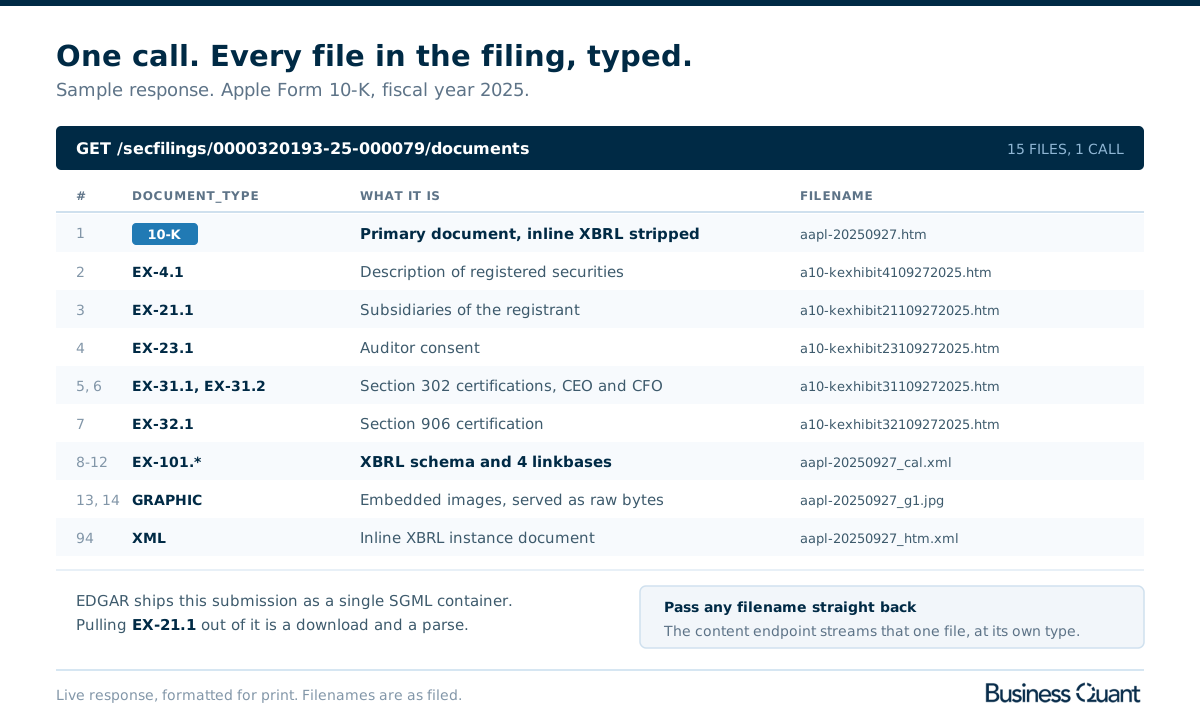
One more thing survives from the same manifest: the XBRL and iXBRL linkbase set stays addressable as raw files, so if you want the calculation linkbase to rebuild the arithmetic yourself you fetch it rather than accepting somebody's JSON conversion. EDGAR keeps those files too. The commercial platforms mostly convert them and hand you the JSON. And because every filing returns both URLs, the canonical sec.gov path and the mirror, you can cite the regulator and pull from the copy.
Pre-extracted sections
Draw one distinction before the comparison, because it decides which column a platform belongs in. EDGAR already pre-renders the financial statement sections: every XBRL filing ships a FilingSummary.xml listing numbered reports, and Apple's fiscal 2025 10-K has 71 of them, from the cover page through the 4 primary statements to the note-level breakdowns. What EDGAR does not extract is the narrative. There is no report in that list for Risk Factors and none for MD&A, and there never has been, because those sections are prose rather than tagged facts.
Narrative extraction is what the specialists sell, and the field is narrower than the marketing suggests. 10-K, 10-Q and 8-K are the mainstream, they cover domestic issuers well, and that is where nearly everyone stops. The moment your universe includes an ADR filing a 20-F or a company mid-IPO filing an S-1, you are back to parsing HTML.
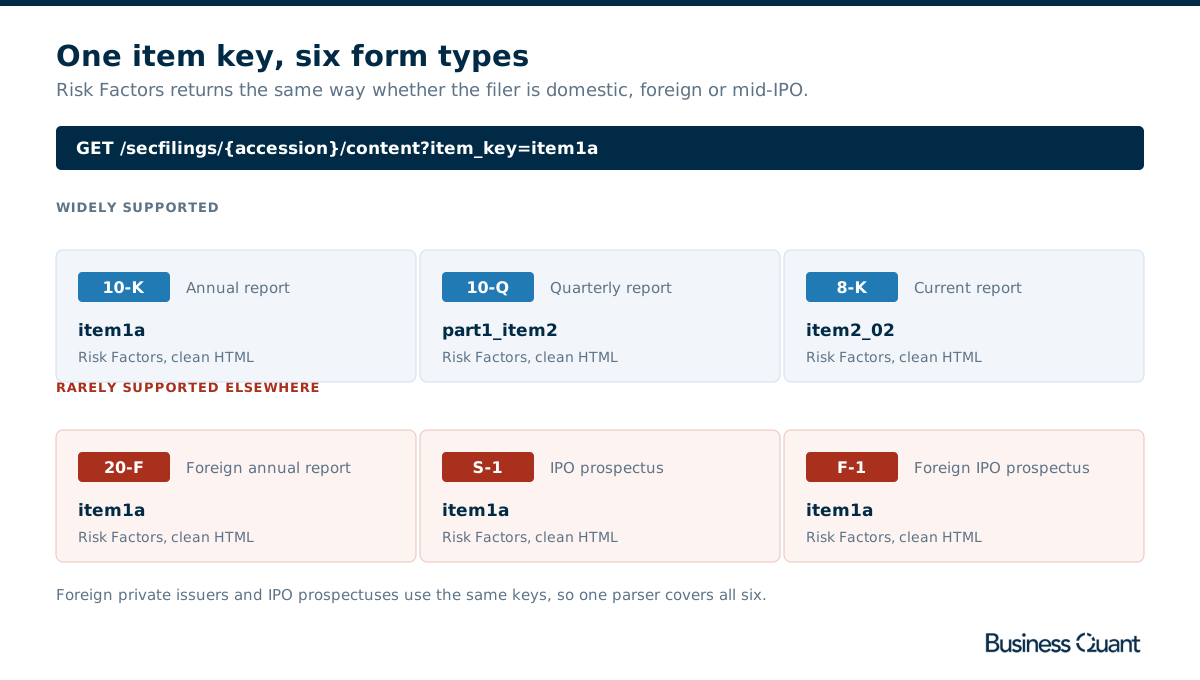
Business Quant covers all 6, keyed by stable identifiers, with a dictionary of roughly 180 keys. On a 10-K that is item1a for Risk Factors and item7 for MD&A; on a 10-Q, part1_item2; on an 8-K, item2_02 for results of operations; on S-1 and F-1 prospectuses, named keys like riskfactors and useofproceeds.
The same split applies here as with the documents. Every one of those sections was extracted, cleaned and written to storage when the filing published, so requesting Item 1A reads a stored record. The other extraction platforms run the parse when your call arrives, which is why their extractor endpoints carry a lower rate limit than the query endpoint beside them, and EdgarTools runs it on your machine. It also means the items endpoint is cheap: asking which sections a filing holds reads a list that already exists rather than triggering a parse to find out.
Where the field thins out
The first table is the summary. This one is the detail, and it is where a 10-name list gets short.
| Platform | Filings in minutes |
Raw XBRL files |
Foreign or IPO form sections |
|---|---|---|---|
| Business Quant | ✓ | ✓ | ✓ |
| EdgarTools | ✓ | ✓ | ✗ |
| SEC EDGAR | ✓ | ✓ | ✗ |
| sec-api.io | ✓ | ✗ | ✗ |
| SEC Filing Data | ✓ | ✗ | ✗ |
| FinFeedAPI | ✓ | ✗ | ✗ |
| Calcbench | ✓ | ✗ | ✗ |
| Quantillium | ✗ | ✗ | ✓ |
| Financial Modeling Prep | ✓ | ✗ | ✗ |
| Intrinio | ✗ | ✗ | ✗ |
Ordered by ticks, with ties in the same order as the table above. A cross means the capability is absent from that platform's published documentation, or excluded at the entry tier, not that it is impossible to build.
One of those columns deserves a sentence. Raw linkbases are rarer than converted ones. Everyone offers XBRL as JSON, which is convenient and lossy. The regulator's archive holds the actual EX-101 files and so does one commercial platform here, which matters if you want to rebuild the arithmetic rather than trust a conversion.
The 10 reviewed
SEC EDGAR
The regulator's own system, and the baseline every paid option is measured against.
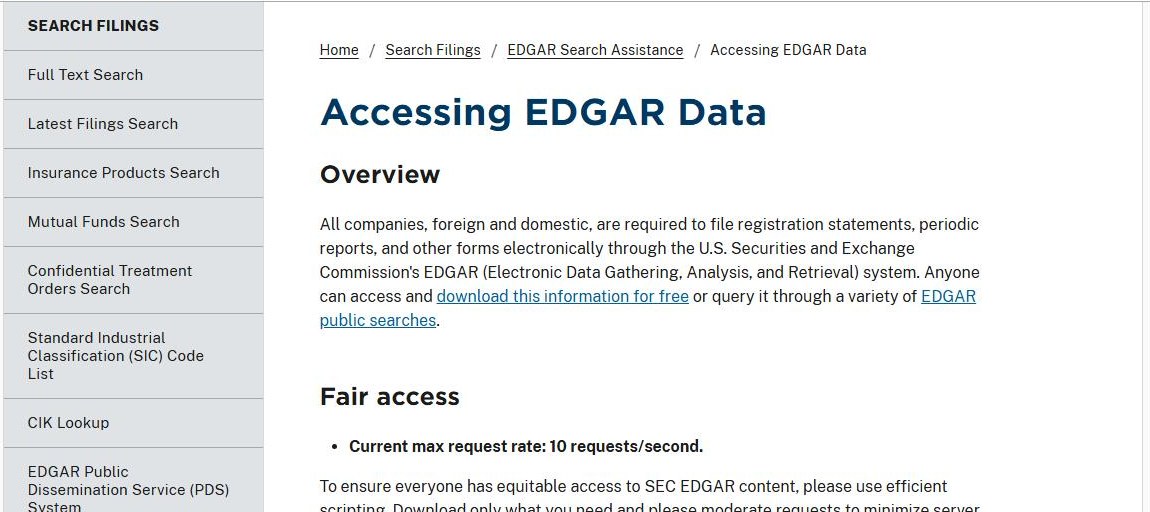
- 10 requests per second per IP, and a User-Agent naming you or a 403.
- The cool-down clock starts when you slow down, not when you are blocked.
- Nightly index rebuilds from about 10pm Eastern, with full and quarterly indexes rebuilt weekly on Saturdays to fold in post-acceptance corrections.
- Bulk archives, a tar and gzip package per filing day, which is the cheapest way to backfill without spending your request budget.
- Full-text search from 2001 only, against an archive starting years earlier.
The SEC also states plainly that it does not offer technical support for developing or debugging scripted processes, which is fair for a free public service and worth knowing before you build a business on it.
EdgarTools
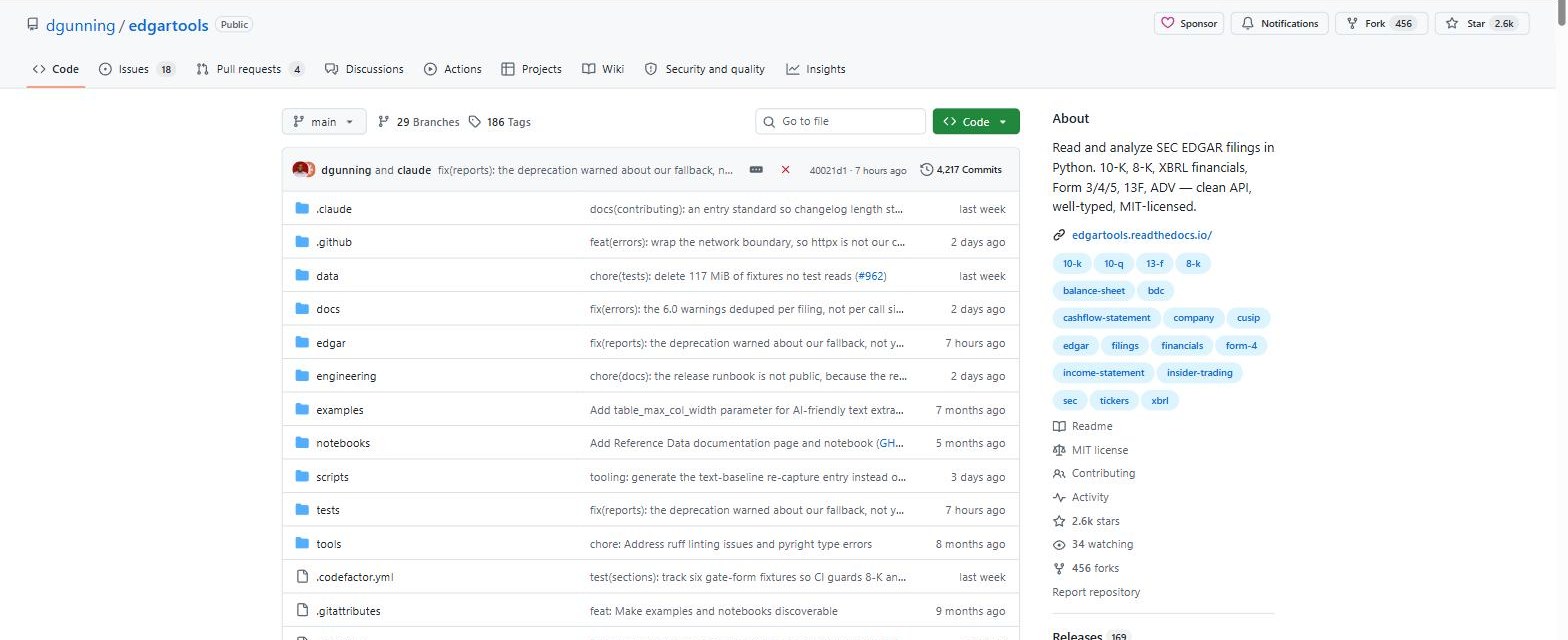
An MIT-licensed Python library by Dwight Gunning, and the only option here that does the parsing on your own hardware.
- 20+ form types as typed objects, covering statements from 10-K and 10-Q, Forms 3, 4 and 5, 13F-HR portfolios, 8-K events and Schedule 13D and 13G.
- Local section extraction including Risk Factors and MD&A, plus EX-21 subsidiary parsing.
- Rate-limit aware with configurable pacing, caching built in, and support for enterprise and academic mirrors.
- Roughly 2,600 stars and 450 forks, with 169 releases, so it is actively maintained rather than abandoned.
- No key and no signup. It asks for an email because EDGAR does.
Because it reads EDGAR directly it inherits both the real-time feed and the split files, which is why it ticks 3 of 3 in the first table. What it inherits with them is EDGAR's 10 requests a second, so it fits the case where structure is your problem and volume is not. The thing to plan for is maintenance, because a local parser is an ongoing commitment: issuers change tagging, restructure documents and file amendments, and drift surfaces as a wrong number rather than a failed request. That is true of ours as much as anyone's. The difference is only who carries it.
Business Quant
Ours, described on the same terms as the other 9. It is 3 products on one key, and each one answers a different question:
- 1. Real-time feed. What has this company filed, and what just landed?
- 2. Pre-split documents. Give me one named file out of that filing.
- 3. Pre-extracted sections. Give me Item 1A as clean text.
Request parameters and sample responses for all 3 are in the documentation: the SEC Filings API, the SEC Filing Documents API and the SEC Filing Section Extraction API.
The 2nd and 3rd are computed at ingestion and held on our own servers, so a request reads storage rather than starting a parse. Filings are also collected straight from the source rather than licensed from an upstream vendor and resold, which is why the refresh cadence and the rate ceiling are ours to set rather than a supplier's.
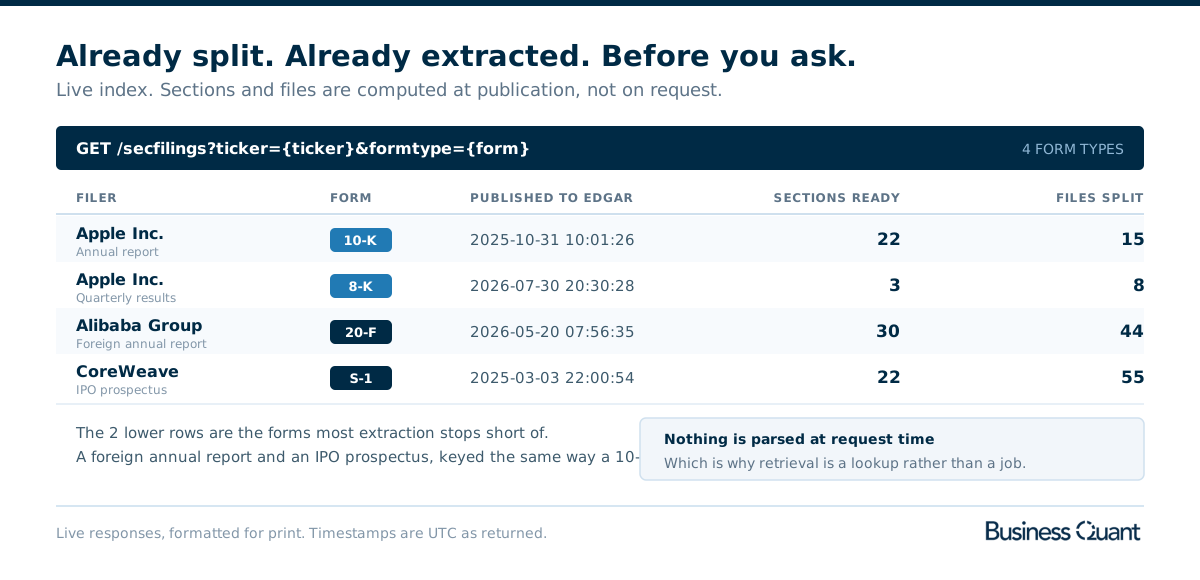
- 1. Real-time feed. 18M+ filings across 400+ form types from 1993, indexed within seconds of EDGAR acceptance.
- 2. Pre-split documents. Every filing split and typed at ingestion, each file addressable.
- 3. Pre-extracted sections. 6 form types, roughly 180 sections, stored at publication.
- A mirrored origin on every filing alongside the
sec.govpath, so bulk exhibit pulls sit outside the 10 per second ceiling. - Statements and ownership in the same index, on shared identifiers.
- Free to use. That covers research and development, and commercial use sits on the enterprise plan.
The boundary worth stating in the same breath: coverage is US-listed issuers and the EDGAR universe. If you need filings from the Tokyo or Bombay exchanges, one of the platforms below is built for that and this one is not.
FinFeedAPI
The SEC product of API Bricks, the company behind CoinAPI, and the most unusual pricing model here.
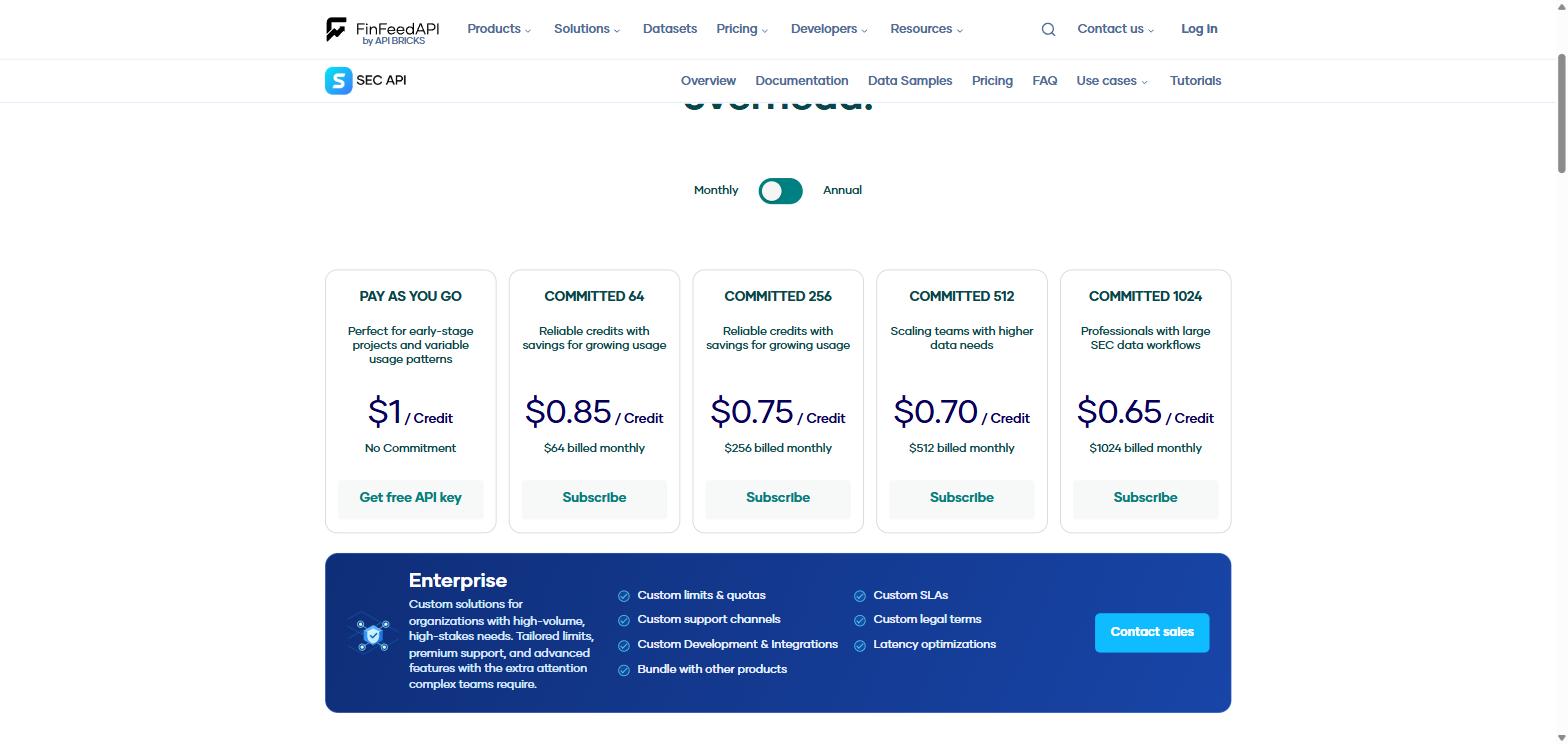
- Nothing is gated by tier, including full-text search and the real-time stream.
- Pay as you go at $1 a credit with no commitment, falling to $0.85 at $64 a month committed, $0.75 at $256, $0.70 at $512 and $0.65 at $1,024.
- Data transfer billed separately, $10 per GiB down to $6.50 at the top tier.
- Autoscaling rate limits on every plan and unlimited API keys, so there is no per-second number to size against.
- 18M filings, 200+ per request, across 10-K, 10-Q, 8-K, S-1, S-3, 20-F and 40-F.
Two things to check before committing. A 99.9% uptime SLA appears only at the $1,024 tier and a latency SLA only on enterprise, so a contractual guarantee is not available at the entry price. And because billing follows bytes rather than calls, the cost of a job depends on how large the filings are, which is harder to forecast than a request count and usually cheaper for narrow, targeted extraction.
Quantillium
Headquartered in Switzerland with operations in Kosovo, and the only option here whose SEC coverage is a subset of something much larger. Judge it on that rather than on the SEC columns, where it takes crosses for things it is not trying to do.
- 50,000+ companies across 60 exchanges, and every plan carries every exchange.
- 7 SEC form types, 10-K, 10-Q, 8-K, 20-F, 40-F, 6-K and DEF 14A, alongside global equivalents and Forms 3, 4 and 5, for 15 product types.
- Pro at $99 a month for 250 API calls a month capped at 50 a day, Team at $299 for 1,000 a month, and Scale at $999 for 5,000 a month, with enterprise above that.
- One call per second on every tier, which is the request rate rather than the monthly allowance.
- History is the tier boundary: 12 months on Pro, 5 years on Team, 10+ years on Scale, against a dataset starting in 2015.
- Standardised sections and English translations on all 3 plans, including on 20-F and 40-F filings, plus original and standardised financial KPI fields.
Read the metering closely, because it is calls per month rather than calls per second and the 2 numbers point in different directions. 250 calls a month is a research budget rather than a pipeline budget, so this is priced for analysts pulling specific filings rather than a crawler walking a universe, and at $99 your history is the last 12 months rather than the archive. What it is genuinely built for is the case none of the other 9 cover: a filer on the Tokyo or Bombay exchange, with its annual report standardised and translated the same way a US-listed peer is.
sec-api.io
Trading as SEC API by D2V, the long-established specialist here and the widest catalogue by a distance. Coverage is 20 million filings across 500+ form types from 1.1 million filers back to 1993, which is the same universe EDGAR holds.
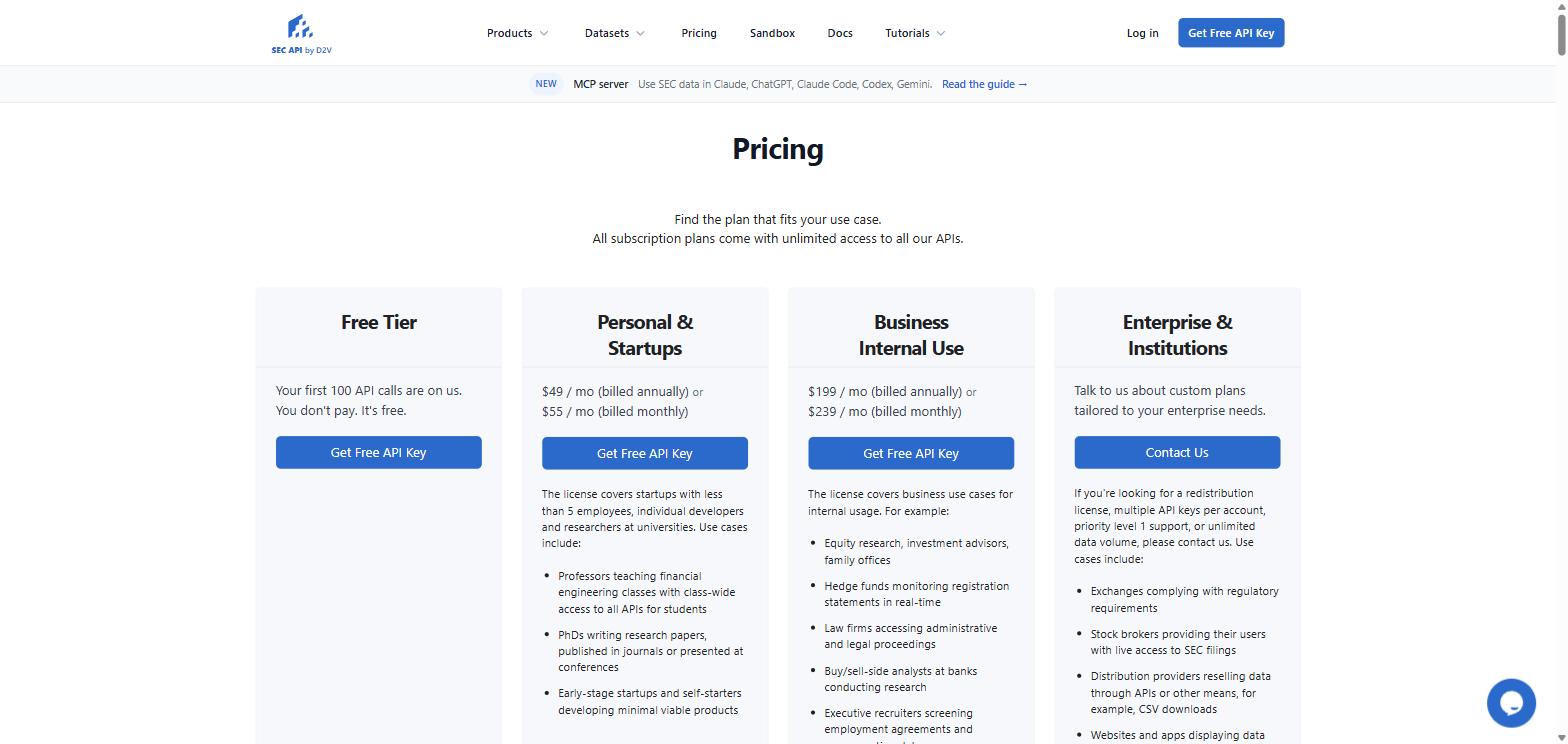
- 100 calls to trial it, then $49 a month, $199 for business, enterprise above.
- Rate limits are per API, not per account, and the extractor runs at half the query rate.
- Full-text search is a Business feature, so price that against $199. The real-time stream is included from the $49 plan.
- 50 GB of data volume a month on Personal and 100 GB on Business, which binds a document-heavy job sooner than the request rate does.
- Around 20 adjacent datasets on the same key, from 13F and 13D/G through Form ADV, N-PORT and executive compensation to the enforcement and AAER databases.
- Redistribution and reselling on Enterprise only. The Personal licence is written for startups under 5 employees, individual developers and university researchers.
Documents come through a download and PDF API rather than a stored manifest, XBRL arrives converted to JSON rather than as linkbase files, and its section extractor covers 10-K, 10-Q and 8-K, which is where its crosses in the second table come from. That extractor rate limit, half the query limit on both paid tiers, is the clearest published illustration of what on-request extraction costs. It has also been doing this considerably longer than we have.
SEC Filing Data
A specialist built around delivery speed, and the fastest published latency on this page.
- Newly published filings in under 200 milliseconds on average, with webhook and email alerts on specific forms, companies or events.
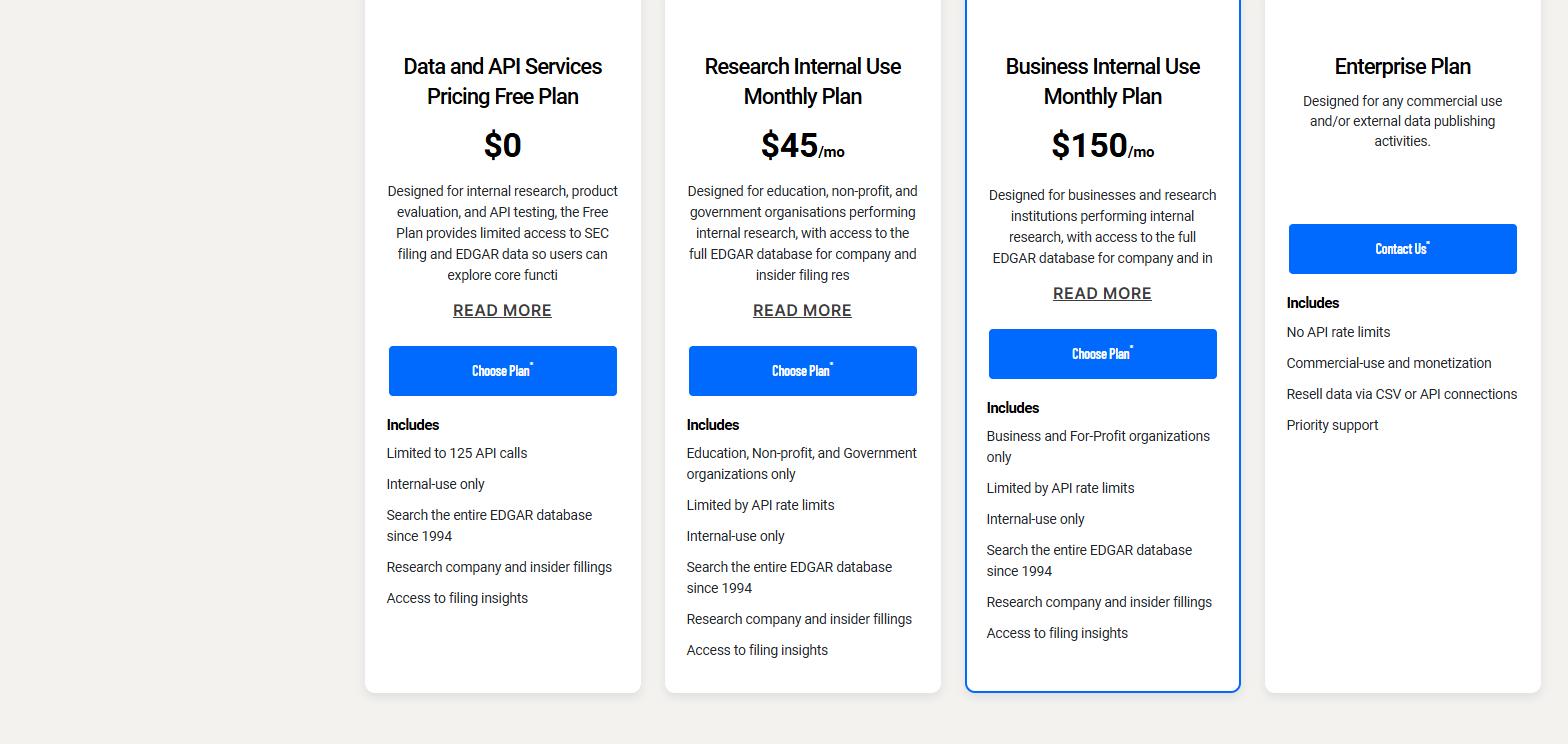
- Free plan limited to 125 API calls, for internal research and testing.
- Research Internal Use at $45 a month or $450 a year, restricted to education, non-profit and government organisations.
- Business Internal Use at $150 a month or $1,500 a year, for for-profit organisations, still internal use only.
- Enterprise removes the rate limits and is the only tier permitting commercial use, monetisation and reselling by CSV or API.
- 18M+ filings across 150+ types, with insider data, Form D and a subsidiaries database.
Settle which tier you qualify for first, because the $45 and $150 plans are eligibility-gated rather than feature-gated and both stop at internal use. If your pipeline output goes in front of customers, enterprise is your entry point and the published numbers tell you nothing about it.
Calcbench
Founded in 2011 by Pranav Ghai and Alex Rapp, out of New York and Cambridge, Massachusetts. It approaches filings from the XBRL end, serving the tagged data underneath rather than the document.
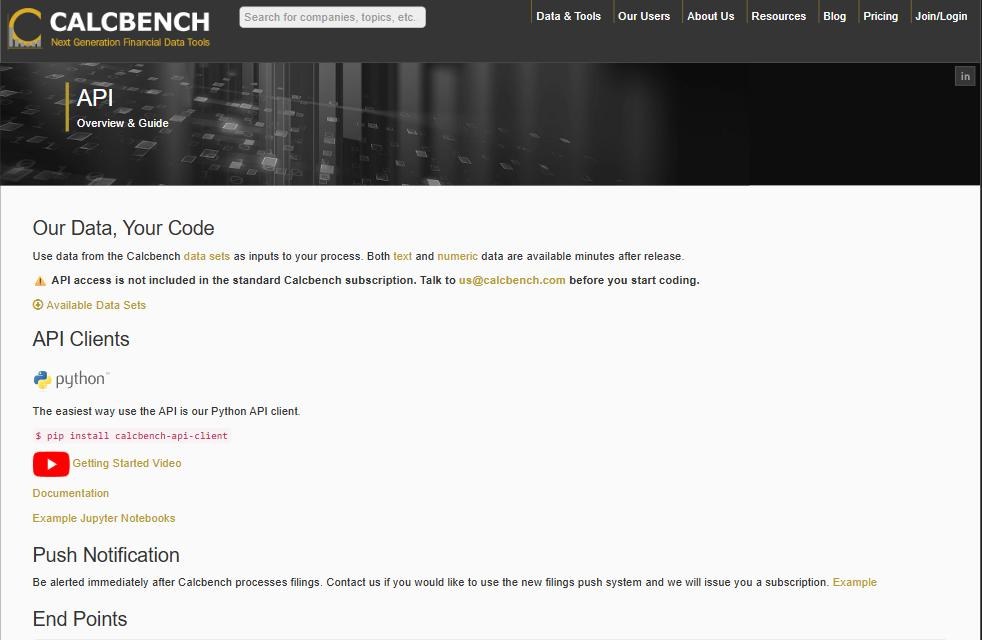
- 12,000+ US-listed companies and, by its own count, more than 500 million searchable data points.
- Numeric and text data minutes after release, with a push notification once a filing is processed.
- Standardised point-in-time numeric data, which matters when you need figures as originally reported rather than as later restated.
- Named narrative sections, Risk Factors and MD&A through to proxy text.
- A Python client on pip,
calcbench-api-client, with documentation and Jupyter notebook examples.
One commercial detail reframes the whole evaluation, so it belongs early: API access is not part of the standard Calcbench subscription and is arranged separately with their team, who ask you to talk to them before you start coding. Budget for a conversation rather than a signup form.
Financial Modeling Prep
Selling data since 2017 and reporting more than 100,000 customers, FMP is a broad self-serve platform where filings are one endpoint family among 150+. It does discovery and stops.
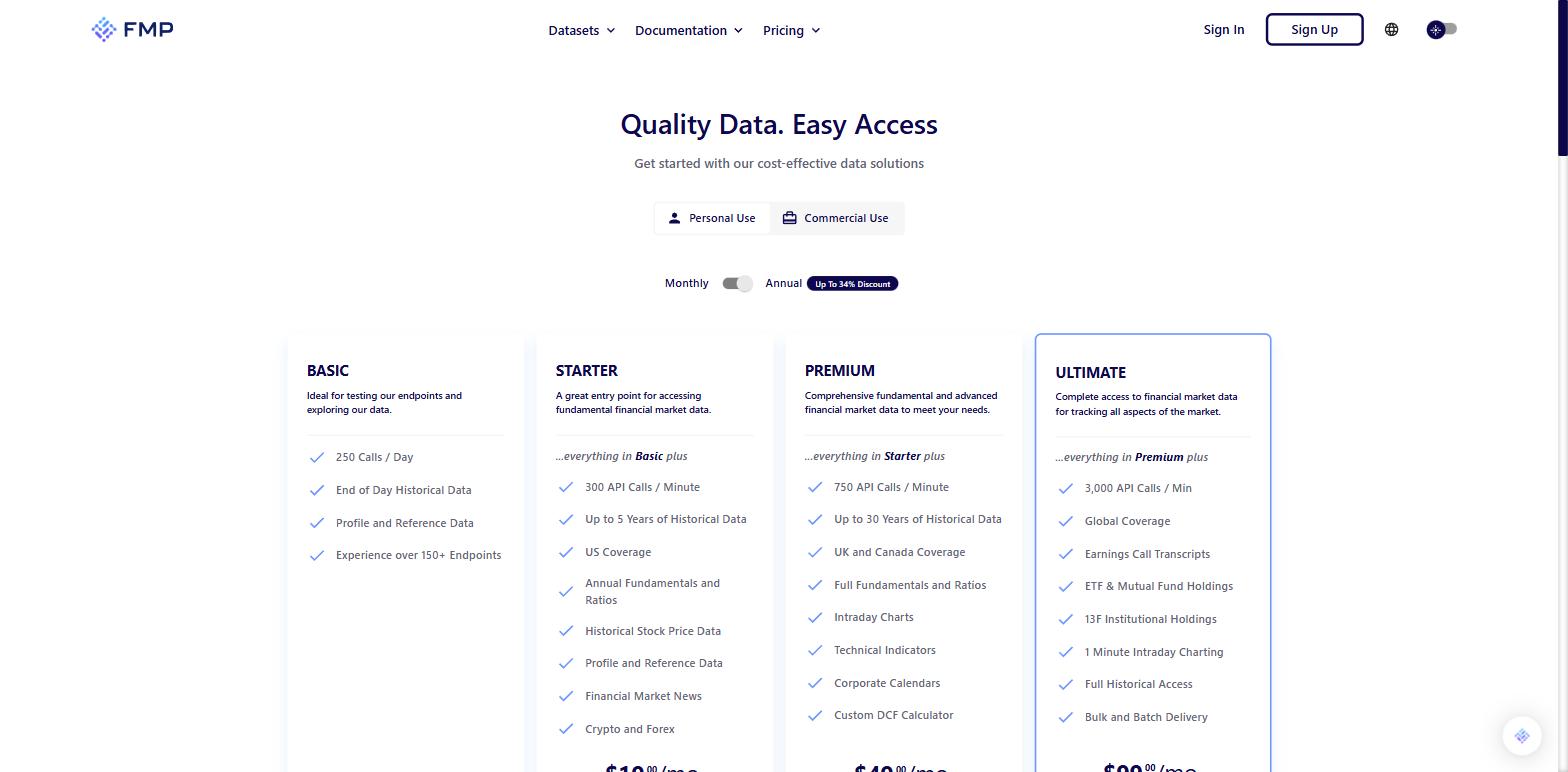
- Discovery is well covered: latest filings, latest 8-K filings, and lookups by form type, symbol, CIK or company name, plus a full SEC company profile.
- Basic is free but end-of-day only. Real-time starts at $19 a month.
- Form 10-K reports as JSON or XLSX, a useful shortcut if you want reported statements rather than narrative.
- A trailing 30-day bandwidth ceiling of 500 MB free, 20 GB Starter, 50 GB Premium and 150 GB Ultimate, which a document-heavy job hits first.
- Display and redistribution need a separate licensing agreement.
What you get is filing metadata and structured financials, not exhibits and not narrative sections. If your requirement is knowing what was filed and pulling the reported numbers alongside prices on one key, that is a good fit at a low price. For how it handles the statements themselves, the financial statements API comparison goes deeper.
Intrinio
Intrinio structures plans around what you are permitted to do rather than which datasets you receive, and its filings surface exists to keep fundamentals in sync rather than to retrieve documents.
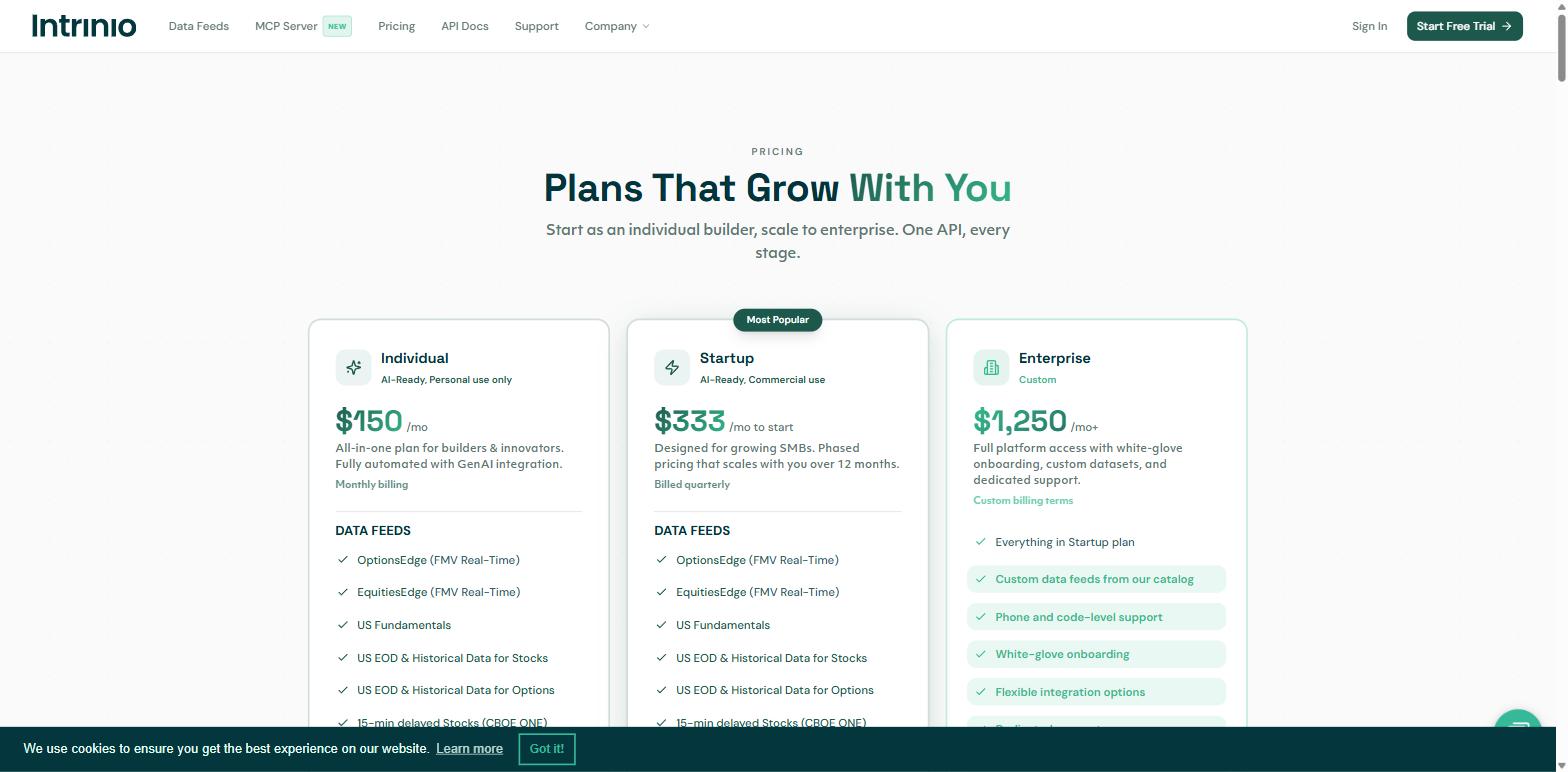
- Individual at $150 a month, personal use, one seat, no redistribution or display rights.
- Startup from $333 a month, phased to $999, carrying commercial and display rights.
- Enterprise from $1,250 a month, with custom feeds, an SLA and a dedicated account manager.
- A filings index that also reports which fundamentals a filing changed.
- Delivery by API, CSV, Snowflake or S3, which matters if your team works in a warehouse rather than against REST.
There is no exhibit access and no narrative section extraction, and filing latency is not published, which is why this row carries no ticks in the second table. If you know you will display these numbers to your own users, the licence tier is the real price and worth modelling from the start.
Filings from the Business Quant API
| What you want | How you get it |
|---|---|
| Everything a company has filed | The filings index, by ticker or CIK |
| Only the forms it actually files | The form-types endpoint, before crawling |
| A whole category of forms at once | formgroup, such as Insider Transaction |
| Ownership and insider filings | 13D, 13G, 13F and Forms 3, 4 and 5 in the index |
| Every file inside a filing | The documents manifest, by accession |
| One named exhibit | Its filename on the content endpoint |
| XBRL linkbases as raw files | EX-101.* rows in the same manifest |
| Exhibits in bulk | The mirrored origin URL, not sec.gov |
| Which sections a filing really has | The items endpoint, keyed by accession |
| Risk Factors as clean text | item1a on a 10-K |
| MD&A as clean text | item7, or part1_item2 on a 10-Q |
| Results on announcement day | item2_02 on the 8-K |
| A foreign issuer's annual report | 20-F, with the same item keys |
| IPO prospectus sections | riskfactors and useofproceeds on S-1 and F-1 |
Where I would start
If you are building anything that reads filings at scale rather than a few hundred at a time, I would start with Business Quant, because it is the only platform here that carries all 3 ticks in the first table and it does the work before the request arrives rather than during it.
That is the whole case and it is checkable against the tables. The feed reflects a filing within seconds of acceptance and answers 2 questions EDGAR cannot: which forms a company has ever filed, and give me everything in this category. Every filing is already split into typed files, so an EX-21 subsidiary list or an EX-101 calculation linkbase is a filename rather than a container to unpack, served from an origin outside the 10 per second ceiling. The sections are already extracted across 6 forms rather than 3, so a 20-F from an ADR and an S-1 from a company mid-IPO return keyed text instead of needing a second parser. The core API is free to use for research and development, so testing that costs an afternoon rather than a purchase order.
Run 3 checks, one per column, in about 20 minutes. Ask for the last 10 filings from a company that reported this week and see how quickly the newest one appears. Ask for the file manifest on its most recent 10-K and see whether the auditor consent and the XBRL linkbases come back as separate addressable files. Then pick a foreign private issuer you follow and ask for its 20-F sections, and see whether you get clean text keyed by item or a document you still have to parse. Do the last 2 across a few hundred filings rather than one, because that is where doing the work in advance stops being an implementation detail.
Filings are usually one input rather than the whole picture. For how they sit alongside prices and fundamentals in a single stack, see the financial statements API comparison, and the EOD stock data API comparison covers the price history side. If you would rather work from a checklist than a shortlist, financial statements API comparison sets out the 5 tests worth running before anything goes into production.
How this comparison was made
One test decided the roster: a documented way to retrieve SEC filings programmatically, whether a commercial API, an open-source library or the regulator's own endpoint. Platforms were not excluded for appearing in other comparisons on this site, because most sell overlapping buckets and holding one back to keep rosters tidy would leave visible holes. Business Quant, which publishes this page, makes one of the 10 platforms compared here.
Two orderings are at work and both are stated so you can check them. The tables are ordered by tick count, highest first, with ties broken by published index breadth, which is why Business Quant leads them and EdgarTools follows: reading EDGAR directly, it inherits both the real-time feed and the split files. The reviews are ordered by category: the free baseline, then the open-source library, then the 5 filings specialists alphabetically, then the XBRL-first option, then the 2 broad platforms, which places Business Quant 3rd rather than 1st.
Both comparison tables are ticks and crosses only, with platforms as rows, so no platform gets a wider column than another and no cell carries a hedge. A tick means the capability is documented and available at the entry tier. A cross means it is absent from the published documentation or excluded at that tier, and the entries say which. Every column is a capability somebody buys rather than an implementation detail.
Limits and prices were read off each platform's own published material rather than lifted from other roundups, with every figure checked on 13 August 2026. The SEC's rate limit, cool-down wording, index rebuild schedule and 2001 full-text boundary come from its own fair-access, security-policy and search pages. Every capability credited to Business Quant, and every section and file count in the illustration above, was confirmed by calling the live API on the same date rather than read off our own documentation.
Image credits. Header photograph by Maksym Kaharlytskyi on Unsplash, used under the Unsplash License. Vendor screenshots were captured on 13 August 2026 from each platform's own pages and are reproduced for comparison. Diagrams are Business Quant originals.
Frequently asked questions
Is the SEC EDGAR API free?
Yes, and it always has been. EDGAR is public data and the official endpoints cost nothing. The constraint is throughput. The SEC publishes a maximum of 10 requests per second and applies it per IP address regardless of how many machines sit behind it, and every request has to carry a User-Agent header naming you with a contact email.
Why pay for an SEC filings API at all?
Because a filings API does 3 things and EDGAR only does the first one, slowly. It tells you a filing exists, it hands you the individual files inside it, and it hands you a named section as clean text. EDGAR does the first 2 well and free, and it leaves the narrative unparsed. It also splits the job in 2: a real-time feed holding about 20 minutes of history, and a queryable index rebuilt overnight. What you are buying is those 2 collapsed into one queryable feed, plus somebody else extracting the prose.
How fast do new SEC filings appear in an API?
It varies more than any other number in this market. EDGAR itself is real-time if you poll the right endpoint: the getcurrent Atom feed carries new filings within about a minute, though it holds only about 20 minutes of history. Its daily index files, which most tutorials use, are rebuilt nightly from about 10pm Eastern, so index-based discovery is next-day. Business Quant indexes a filing within seconds of EDGAR accepting it, SEC Filing Data quotes under 200 milliseconds on average, Calcbench quotes minutes, and Quantillium processes daily with filings available by midnight. If you are building alerting rather than research, this is the number that decides it.
How do I get a single exhibit out of an SEC filing?
From EDGAR itself, read the filing index page for that accession: it lists every document with its SEC type code and filename, and you fetch the one you want. That means parsing an HTML page, and the files sit inside the 10 requests a second budget. Business Quant returns the same manifest as JSON keyed by accession, from its own origin, with the primary document stored minus its inline XBRL tags.
Can I extract 10-K sections without writing a parser?
Yes. Business Quant extracts sections when the filing is published and stores them against stable item identifiers across 10-K, 10-Q, 8-K, 20-F, S-1 and F-1, so a foreign private issuer or an IPO prospectus comes back the same way a domestic 10-K does. sec-api.io, FinFeedAPI, SEC Filing Data and Calcbench also return sections, generally across the 3 domestic forms. Check which forms each one covers rather than assuming section extraction means the same thing everywhere.