9 Best Insider Trading Data APIs
Most insider feeds hand you acquisitions and disposals. The useful ones tell you which were bought with money, and adjust the share counts for splits.


This dataset has a property that makes it unusually easy to get wrong: it is legible. Anyone can open a filing and read that a chief executive acquired 125,000 shares. No parsing expertise required, no XBRL, no normalisation. Which is precisely why so many insider dashboards report numbers that are technically accurate and completely misleading.
3 things separate a usable insider feed from a stream of rows.
- The transaction code. Acquisitions include open market purchases, option exercises, grants, gifts and inheritances. They mean entirely different things and they all increase the share count.
- Split adjustment. Historical share figures are filed as they stood. A position that looks like it quadrupled may just be a company that split 4-for-1.
- Amendments. Form 4 filings get corrected, sometimes materially, and a feed that appends the amendment rather than superseding the original will double count.
Every product below returns insider transaction data parsed from Forms 3, 4 and 5 through a documented API. Some are specialists and some carry it alongside other datasets, which is worth knowing but is not a reason to leave one out. For the quarterly holdings side of ownership rather than individual transactions, see the institutional ownership comparison.
Not every acquisition is a purchase
The single most valuable field in this dataset is a letter. The SEC transaction code tells you what actually happened, and the difference between the codes is the difference between a signal and a payroll event.
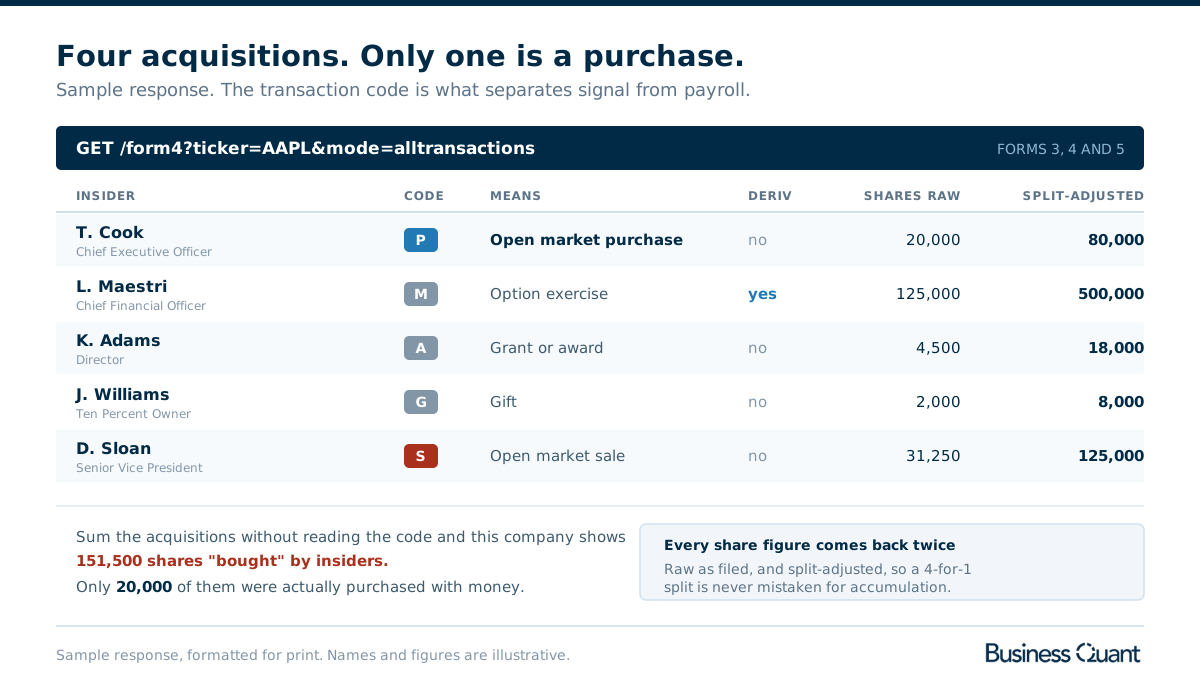
The codes worth knowing before you write a filter:
- P, open market purchase. The executive spent their own money at the prevailing price. This is the one the research literature is about.
- S, open market sale. Genuine, but weakly informative on its own, because diversification, tax bills and school fees all look identical to a signal.
- M, exercise of a derivative. Converting options into stock. It increases holdings and tells you almost nothing about conviction, since the alternative was letting the grant expire.
- A, grant or award. Compensation. The company gave them shares.
- G, gift. Frequently estate planning, often to a trust or a charity.
- F, shares withheld for tax. Technically a disposal, mechanically automatic, and a common cause of alarming-looking sale clusters right after a vesting date.
Filter to P and S and the dataset becomes tractable. Skip that step and you will find yourself explaining why insiders appear to be buying heavily into a decline when what actually happened was a scheduled vest.
The related trap is the 10b5-1 plan. Executives set up trading schedules in advance precisely so they can transact without accusations of trading on inside knowledge, and a sale executing on that schedule carries almost no information. A discretionary sale on the same day carries a great deal. Any provider that does not let you separate the two is handing you noise with a signal buried in it.
Amendments, and why your buy count drifts
The second thing that quietly corrupts an insider pipeline is correction. Form 4 filings are amended more often than most people expect, and the amendments arrive days or weeks after the original, long after your job processed it.
They get amended for ordinary reasons: a share count typed wrong, a transaction date corrected, a security misclassified as non-derivative when it was derivative, a holding restated after the filer realised shares held in a family trust belonged in the indirect column. None of it is dramatic. All of it changes numbers you have already stored.
There are 2 ways a provider can hand this to you, and the difference matters more than it sounds.
- Supersede. The amendment replaces the original, and querying the period returns the corrected view. Clean for reporting, and it means a query you ran last month may not reproduce today.
- Append. Both records are returned and you decide. Honest, and the cause of the classic bug where a corrected filing is counted twice and a director appears to have bought the same block on 2 occasions.
Neither approach is wrong, and a provider choosing either is fine. Not knowing which one you are getting is the problem, because the correct handling in your code is the opposite in each case. Ask before you build, and if you are storing rows rather than querying live, key on the accession number so a re-run can tell a correction from a new event.
This is also the reason a long history and fast delivery pull in different directions. A feed optimised for speed tells you about a filing within a minute. Whether it tells you 3 weeks later that the filing changed is a separate question, and worth asking separately.
How the 9 compare
- 2iQ Research
- The Washington Service
- Benzinga
- sec-api.io
- Kaleidoscope
- Fintel
- Quiver Quantitative
- Form4API
- Business Quant
| Provider | Geography | History | Delivery | Entry |
|---|---|---|---|---|
| 2iQ Research | 50 countries | 12 years average | Feed and API | On contact |
| The Washington Service | US | Not published | API, up to the minute | On contact |
| Benzinga | US | Since 2003 | Intraday | On contact |
| sec-api.io | US | Since 2003 | REST, paginated | $49/mo |
| Kaleidoscope | US | Not published | REST | On request |
| Fintel | US and international | Not published | API, licensed separately | $10.95/mo |
| Quiver Quantitative | US | Not published | REST and MCP | $75/mo |
| Form4API | US | Since Apr 2023 | Webhooks, ~60s | $0 tier |
| Business Quant | US | Full EDGAR era | REST, ~5 min | $0 |
Scroll the table sideways to see every column. Several institutional specialists price on contact rather than publishing rates.
A closer look at each
2iQ Research
2iQ has been doing this since 2002 and is the only genuinely global option here. Where everything else on this page stops at the US border, 2iQ covers insider transactions across 50 countries, which is a materially harder problem: every jurisdiction has its own disclosure regime, filing format, language and deadline.
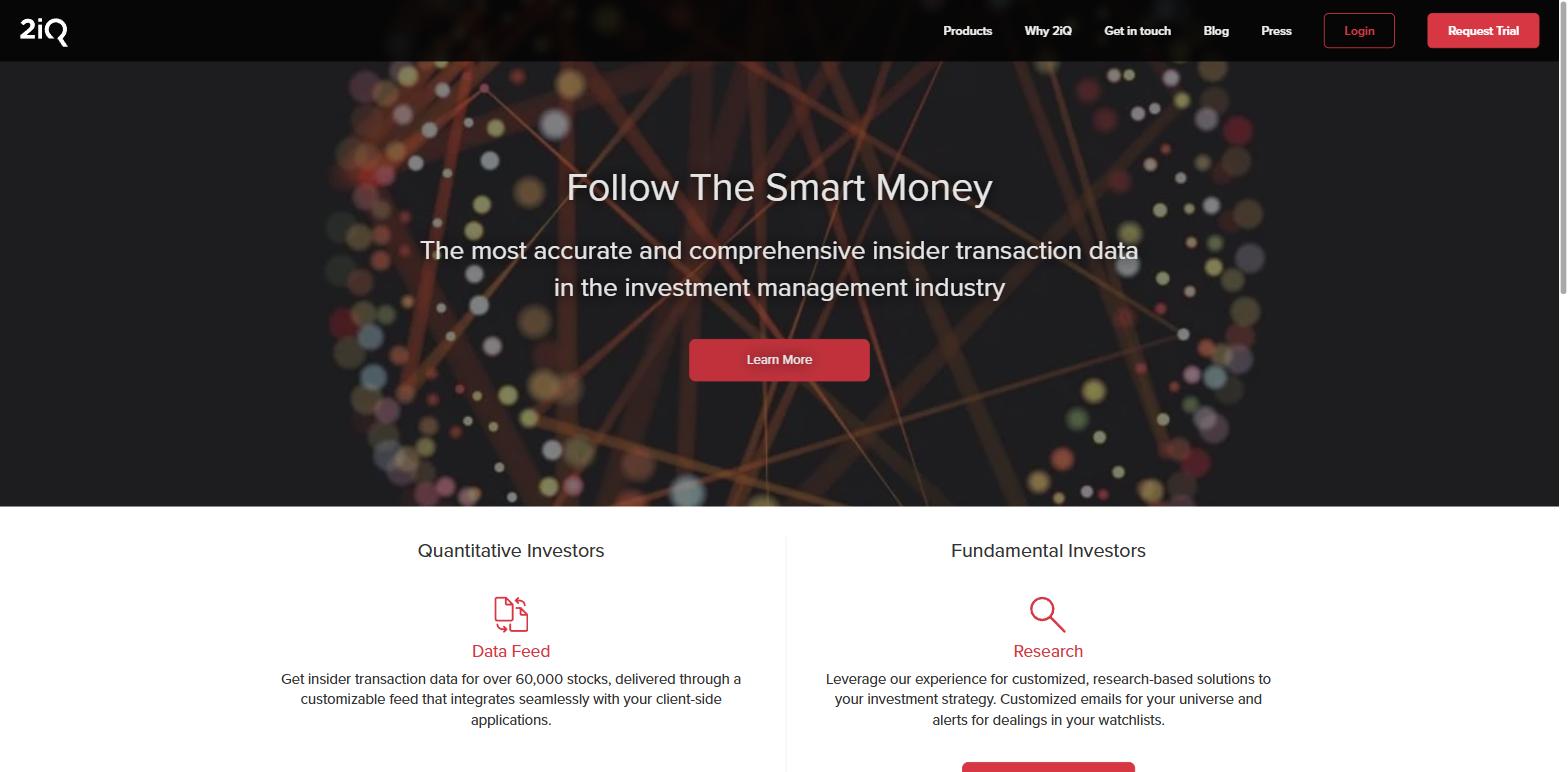
- 8.1 million transactions by more than 200,000 insiders across over 60,000 stocks.
- 12 years of history on average, which for a multi-country dataset assembled from dozens of regimes is substantial.
- Data feed, API, custom delivery and advisory, sold to fundamental and quantitative desks as separate propositions.
- Sentiment and scoring layered on top, rather than raw filings alone.
If your universe includes European or Asian equities, this is close to the only serious answer, and the alternative is building 50 country-specific parsers. The trade-off is that it is sold as an institutional data subscription, so expect a sales process and a contract rather than a signup form.
The Washington Service
The Washington Service is the long-standing US institutional reference for ownership filings, and it carries something nobody else on this page does: Form 144, the notice filed before a proposed sale of restricted stock.

- Forms 4, 5 and 144, derived directly from SEC ownership filings.
- Form 144 is the forward-looking piece. It signals intent to sell before the sale, where Form 4 reports it afterwards.
- Up-to-the-minute delivery through the API rather than batched.
- Priced on contact, in line with its institutional client base.
That Form 144 coverage is the reason to look here specifically. If your work involves anticipating supply rather than reacting to it, no amount of Form 4 data substitutes for the notice that precedes the trade.
Benzinga
Benzinga sells insider trades as one product in a broad market-data catalogue, and the shape reflects that: wide US coverage, a conventional REST experience, and documentation aimed at developers rather than economists.
- Coverage of the Wilshire 5000 plus roughly 1,000 additional US equities, which is effectively the investable US market including a long tail of small caps.
- History from 2003 onward.
- Intraday delivery rather than end-of-day batches.
- Part of a wider catalogue, so news, earnings and ratings sit behind the same integration.
The case for Benzinga is consolidation. If you already need news or corporate events, adding insider trades is an endpoint rather than a vendor, and that has real value beyond the data itself.
sec-api.io
The most completely specified insider dataset in this comparison, and the query surface is where it earns that.
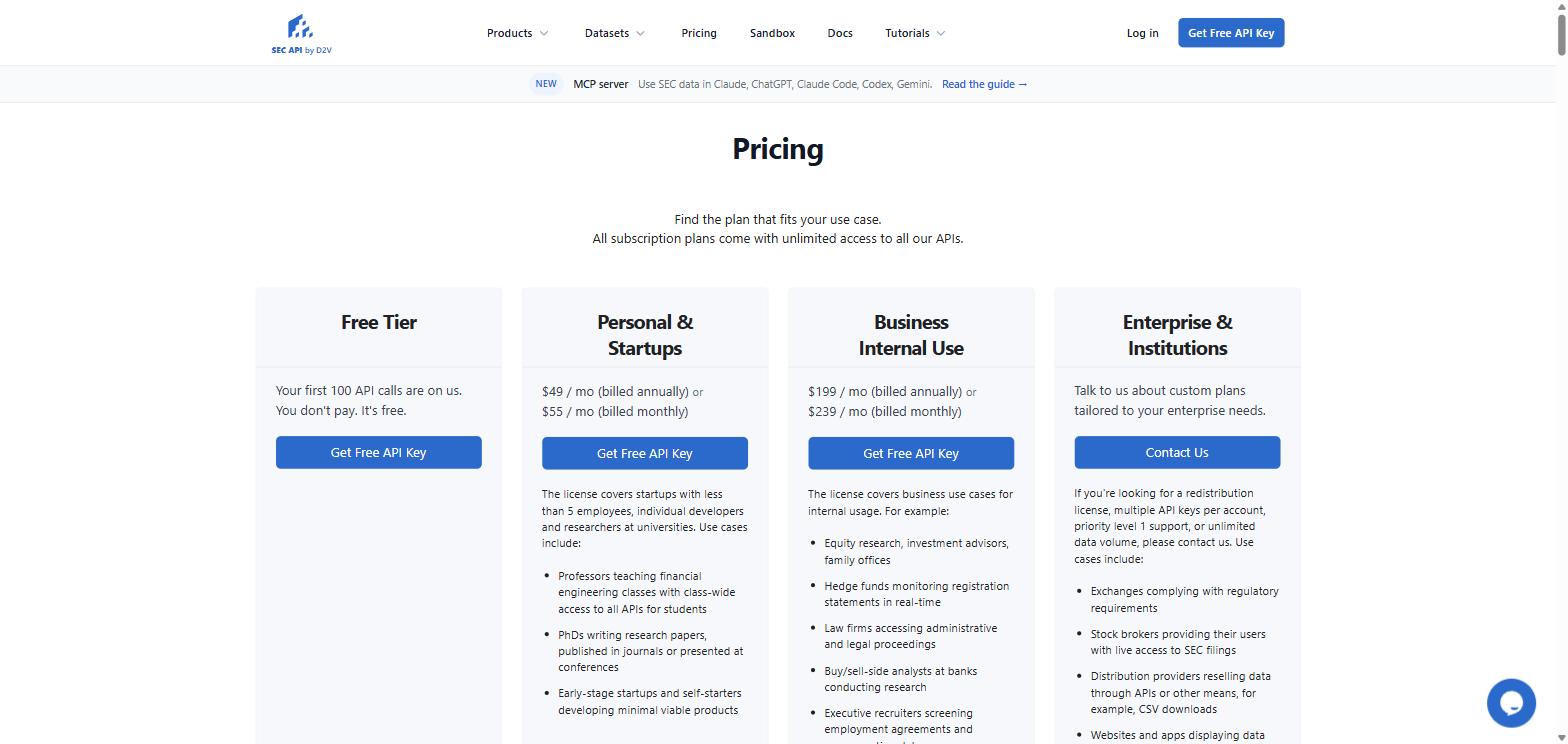
- 11.4 million insider transactions, 8.27 million non-derivative and 3.15 million derivative.
- All Form 3, 4 and 5 filings and their amendments since 2003, which means the amendment problem described above is at least visible in the data.
- Query by issuer or by insider. Pass a symbol or CIK for the company, or a reporting owner CIK or name to follow one person across every company they are affiliated with.
- Filter on relationship, separating directors, officers and 10% owners, and on transaction code and date.
- Rule 10b5-1 flagging, marking trades made under a pre-arranged plan.
- 50 results per query with pagination through a
fromparameter, on plans starting at $49 a month.
The 10b5-1 flag deserves the attention. A sale executed under a plan adopted 9 months ago carries almost no information about what the executive thinks today, and lumping it in with a discretionary sale is exactly the error that makes insider dashboards noisy.
Kaleidoscope
Kaleidoscope carries insider data as part of a wider SEC platform, and its form coverage goes one step further than most.
- Forms 3, 4, 5 and 144, the last being notice of a sale before it happens.
- 13F holdings alongside, covering 5,000+ investors since 1999 with quarterly position diffs, so transactions and holdings sit under one key.
- 18M+ filings since 1994 across 400+ form types with full-text boolean search.
- Pricing is not published, and integrations run through their sales team.
Form 144 alongside Form 4 is a genuinely different picture. One tells you what an insider intends to sell, the other tells you what they did sell, and having both lets you see intent and execution rather than only the aftermath.
Fintel
Fintel pairs Form 4 insider transactions with the short side of the market, which is an unusual combination at retail pricing.
- Form 4 insider transactions sourced directly from the SEC, traceable back to the filing that produced each row, alongside 13F and 13D/G institutional filings.
- Coverage runs to hundreds of thousands of securities and thousands of funds, including international markets, which is broader than the US-only specialists here.
- Short interest, FINRA off-exchange short volume, fails-to-deliver and borrow rates sit beside the insider data.
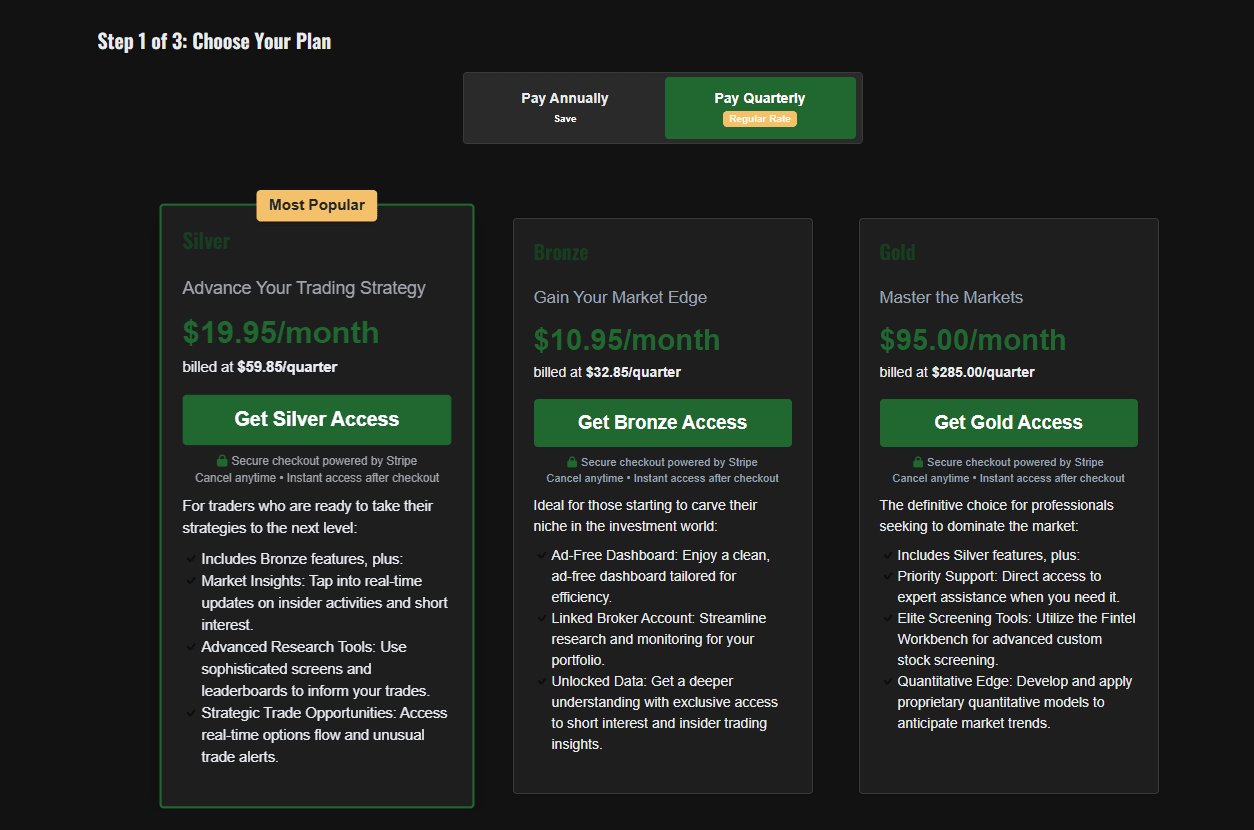
- Dashboard plans run $10.95, $19.95 and $95.00 a month, billed quarterly, and the API is licensed separately from those.
Seeing insider buying against rising borrow costs on the same screen is a real analytical advantage, and assembling those inputs from primary sources yourself is a project rather than an afternoon.
Quiver Quantitative
Quiver treats insider trading as one feed among a set of disclosure datasets that nobody else was structuring.
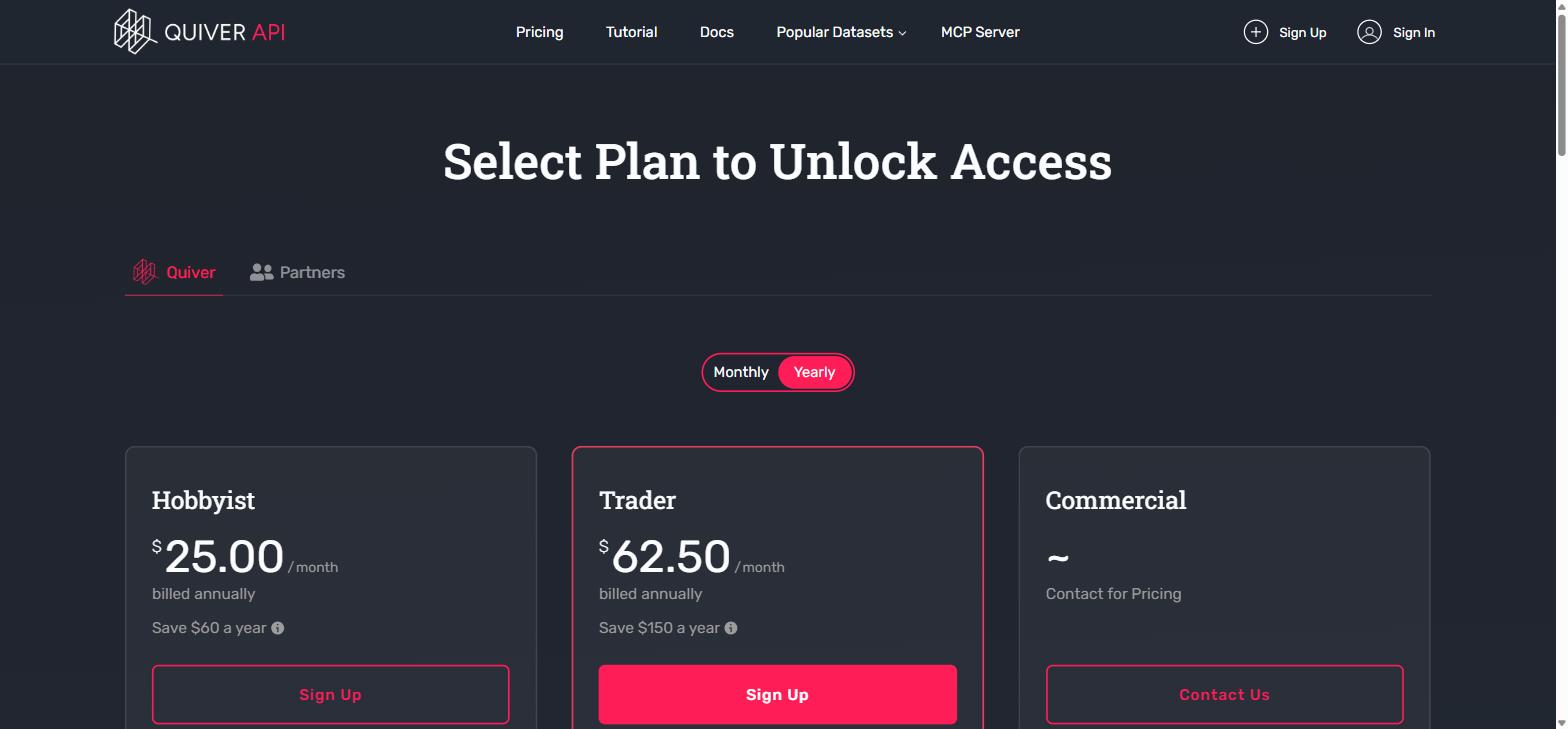
- Insider trading and top shareholders begin on the Trader plan at $75 a month, or $62.50 annually.
- Congressional and senate trading sit alongside, which is the dataset Quiver is best known for and a natural companion to corporate insider activity.
- Lobbying, government contracts, patents and executive compensation round out the disclosure set.
- All 18 MCP tools on the Trader plan, with the same key working across REST and MCP.
- The Hobbyist plan at $30 carries no insider data, so $75 is the real entry point, and both self-serve tiers are non-commercial.
If the question you are asking spans corporate insiders and elected officials, this is the only place in this comparison where both arrive under one key.
Form4API
Form4API is the most developer-shaped product in this comparison, and it solves for a specific job: knowing about a filing within a minute and never double counting an amendment.
- HMAC-signed webhooks, so filings are pushed to you rather than polled for.
- Roughly 60 seconds from SEC acceptance, the fastest published figure here.
- Amendment-aware parsing, which is a deliberate design decision rather than a footnote and the thing most naive pipelines get wrong.
- An institutional ownership block on each transaction row, carrying current-quarter assets, the quarter-over-quarter trend and the top 3 institutional holders.
- A free tier, with Pro, Business and Enterprise above it.
The constraint is history. Coverage runs from April 2023, about 1.3 million transactions, so this is built for monitoring what happens next rather than studying what happened before. For an alerting pipeline that is exactly right. For a backtest over a market cycle it is not enough on its own.
Business Quant
Our own API is built around the assumption that you will need to separate real purchases from mechanical ones, and that you will need historical figures that survive a stock split.
- Every share figure returns twice, raw as filed and split-adjusted.
- Full transaction detail, down to conversion price and nature of ownership.
- Direct and indirect holdings are separated, so shares held through a trust or a family partnership are not silently merged with shares held outright.
- 5 query modes, from every transaction to net activity by quarter.
- Insider percentage of shares outstanding is computed for you rather than left as a division you do against a separate source.
- Published within about 5 minutes of the filing appearing, across the full EDGAR era rather than a recent window.
- The same key covers 13F holdings, filings, statements and segments.
Query modes, fields and a sample response are in the Insider Trading API documentation.
The honest boundary is geography. This is US filings. If your universe is European or Asian, 2iQ is built for that and this is not, and no amount of depth on US names changes it.
Filtering insider data with the Business Quant API
| What you want | How you get it |
|---|---|
| Only genuine open market buys | Filter transaction_code to P |
| Option exercises excluded | Filter on is_derivative |
| Share counts that survive a split | The _adjusted fields |
| Who at this company is buying | Insider summary mode |
| Whether insider buying is broadening | Net trading activity, with active insider counts |
| How much of the company insiders hold | insider_pct on top holders |
| Holdings through trusts separated out | ownership_d and ownership_i |
| Insider flows next to institutional flows | Same key, the 13F endpoint |
The test that settles it
If your universe is US-listed and you want insider data you can filter honestly on the first afternoon, start with Business Quant.
The reasoning is narrow. You get the transaction code and a derivative flag, so separating a purchase from a vest is a filter rather than a research project. You get raw and split-adjusted figures side by side, so historical comparisons hold. You get direct and indirect holdings separated. You get the count of active insiders per quarter, which is what tells you whether buying is broad or one enthusiastic director. And it costs nothing to check.
Run this test, because it takes 15 minutes and it exposes the difference between providers immediately. Pick a company that has split in the last few years. Pull every insider transaction, sum the acquisitions, then sum again filtered to code P and using the adjusted share counts. The gap between those 2 numbers is the amount of noise most insider dashboards are reporting as signal.
That gap is the whole argument. Insider data is only useful if you can tell a considered purchase from an automatic vest, and most of the disappointment with this dataset traces back to a sum that quietly mixed the two.
For the quarterly holdings side of ownership, see the institutional ownership API comparison. For the filings underneath all of it, the SEC filings comparison covers that ground.
How this comparison was made
One test decided the roster: a documented API that returns insider transaction data parsed from Forms 3, 4 and 5. Providers were not excluded for carrying insider data alongside other datasets, or for appearing in other comparisons on this site, because most of them sell overlapping buckets and holding one back to keep rosters tidy would leave visible holes.
Prices, limits and coverage figures were read off each vendor's own published material on 13 August 2026, not from other roundups, and screenshots are dated where they appear. Where a vendor does not publish a figure, the table says so rather than carrying an estimate.
Every provider here is described from its own published material rather than characterised, and Business Quant appears in roster order rather than at the top. Business Quant, which publishes this page, makes one of the 9 products compared here.
Image credits. Header photograph by Markus Winkler on Unsplash, used under the Unsplash License. Diagrams are Business Quant originals.
Frequently asked questions
Is there a free insider trading API?
Business Quant is free to use for insider transactions across Forms 3, 4 and 5, with commercial distribution on the enterprise plan. Form4API publishes a free tier as well. The specialists in this category sell to institutions and price on contact, because the buyers are funds rather than developers.
How quickly does insider trading data appear after a filing?
Form 4 is due within 2 business days of the trade, and providers publish anywhere from about 60 seconds to a few minutes after the filing is accepted. Business Quant processes within about 5 minutes. Unlike quarterly holdings data, this genuinely is close to real time, so latency is worth comparing.
Does insider buying actually predict anything?
Open market purchases have been studied for decades and carry more signal than sales, on the reasoning that executives sell for many reasons and buy for one. The caveat is that most reported acquisitions are not purchases at all. Filter on the transaction code before you draw any conclusion.
What is a 10b5-1 plan and why does it matter?
It is a pre-arranged trading schedule set up in advance, so the trade executes on a timetable rather than a decision. A sale under a 10b5-1 plan carries far less information than a discretionary one, and treating the two identically is the most common way to misread a stream of insider sales.