8 Best Hedge Fund Trackers for 2027
Every hedge fund tracker reads the same 13F filings. Which one shows you what changed, for the fund or the stock you actually care about?


Investment managers with more than $100 million in US-listed stocks file a 13F with the SEC each quarter, listing their long positions. A hedge fund tracker reads those filings and shows each fund's holdings, what changed from the prior quarter, and which funds hold a given stock.
Below are 8 hedge fund trackers. We compare them on coverage, holders by stock, insider trades, export, API access and price.
Why the same 13F can be counted 3 ways
Every 13F is late by design. A manager has 45 days after a quarter ends to file, and Appaloosa, David Tepper's fund, filed its June 2026 portfolio on 14 August 2026, day 45. Whatever a tracker shows on the morning it updates is already 6 weeks old, so the useful question is what the fund changed, and whether other funds made the same move.
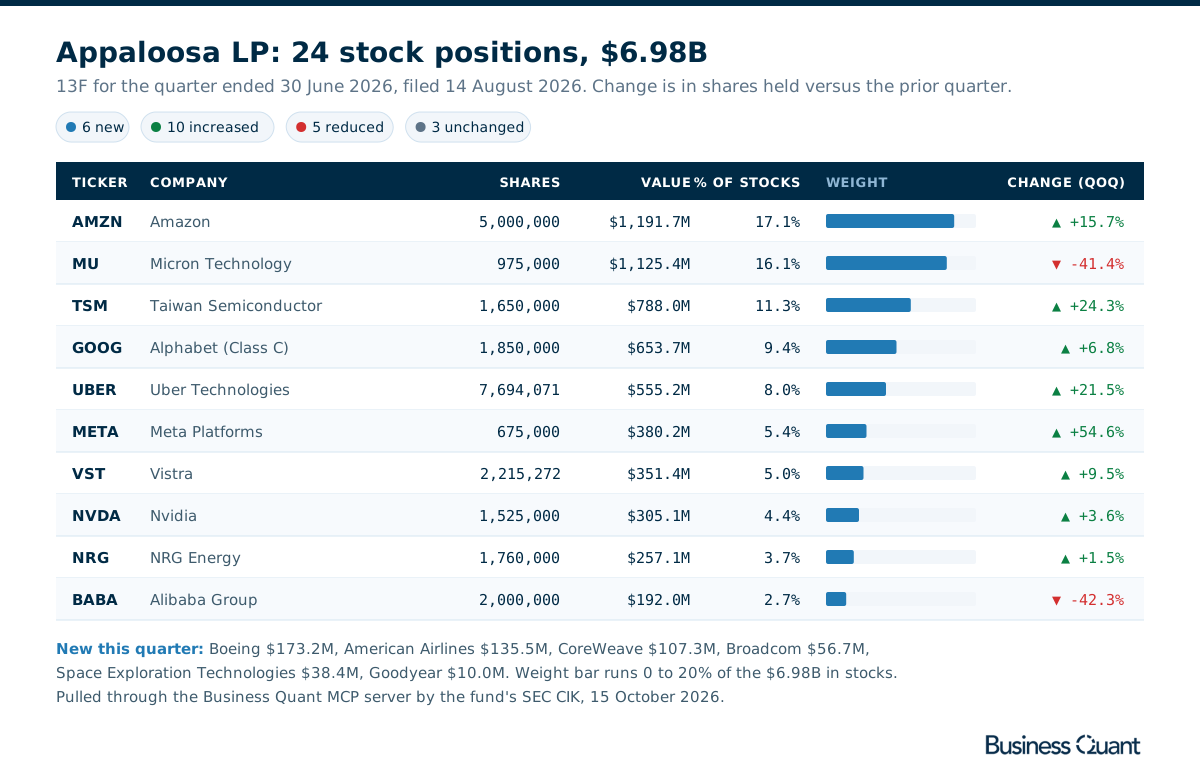
The total depends on what a tracker counts. That Appaloosa filing lists 27 holdings worth $7.73 billion. 2 of them are put options, on Apple and Berkshire Hathaway, and one is an iShares MSCI South Korea ETF. Count everything and the portfolio is $7.73 billion in 27 holdings; leave out the puts and it is $7.47 billion in 25; keep only the stocks and it is $6.98 billion across 24. All 3 are correct readings of one document, and a position's weight changes between them.
Every tracker here is built on SEC EDGAR, which publishes each 13F free on the day it is filed. EDGAR shows one quarter at a time, so working out what changed means putting 2 filings side by side yourself, and that comparison is what the products below do for you.
How to choose a hedge fund tracker
- Coverage. Every 13F filer, or a hand-picked list of famous managers.
- Direction. Fund to portfolio, stock to holders, or both.
- Changes, not just holdings. New, added, reduced and sold positions, computed for you.
- What sits next to it. Insider trades, filings and the company's own numbers.
- Price and history. How many quarters you see at no cost, and what a plan unlocks.
If your interest is the people inside a company rather than the funds around it, our insider trading websites guide covers Form 4 trackers.
The 8 hedge fund trackers at a glance
| Platform | Best for | Plans from |
|---|---|---|
| 13F.info | Comparing 2 quarters of raw filings | $0 |
| Dataroma | Following famous value investors | $0 |
| HedgeFollow | Broad fund tracking on a budget | $10/mo |
| HoldingsIntel | Scored signals on the largest funds | $16/mo |
| Stockcircle | Guru portfolios with trade alerts | $8.25/mo |
| TIKR | Fund holdings inside a research terminal | $17.95/mo |
| WhaleWisdom | Deep 13F history and backtesting | $300/yr |
| Business Quant | Every 13F holder of a stock and its change, beside insider trades and financials, with export and API access | $29/mo |
Rows are alphabetical, Business Quant last. "Plans from" is the cheapest paid plan's lowest advertised monthly price on 15 October 2026; $0 means the site has no paid plan, and WhaleWisdom prices by the quarter or the year, so its yearly price is shown.
Hedge fund trackers reviewed
13F.info
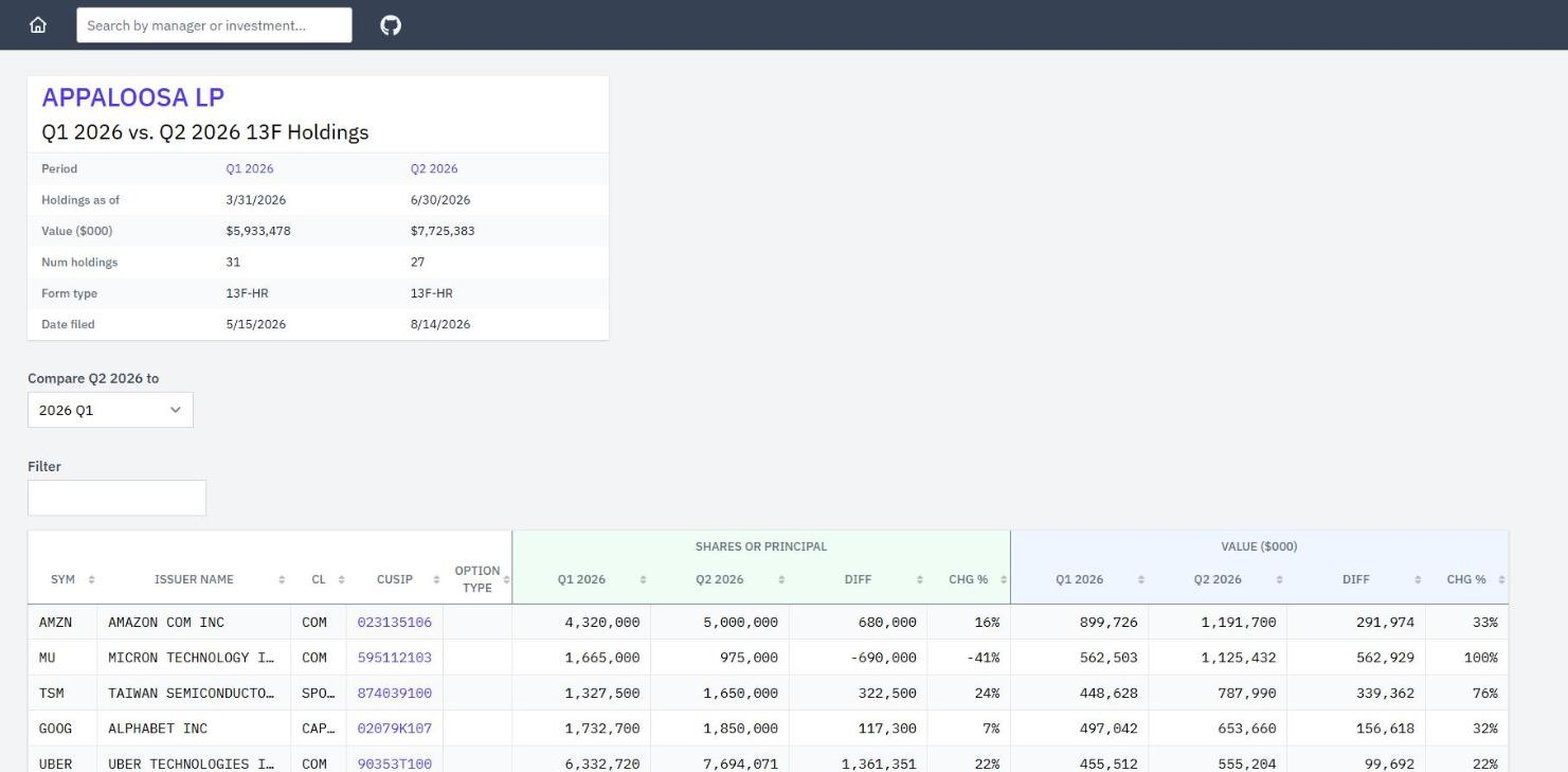
13F.info is a one-person project that lays 13F filings out cleanly and lets you compare any 2 quarters side by side. Its author built it because EDGAR's formatting "is not ideal", and the code is public on GitHub.
- Best for comparing 2 quarters of raw filings.
- No account and no paid plan.
- Every 13F manager, indexed A to Z.
- Quarter comparison in shares and value, with the change in each.
- Holders of any stock in a chosen quarter, and Form D search.
Because it shows the filing as filed, 13F.info is the most faithful view in this list: Appaloosa's June 2026 portfolio appears as 27 holdings and $7.73 billion, puts and ETF included, with option type in its own column. You can also follow one manager's position in one stock across every quarter it was reported.
Where it falls short: it does not interpret. There are no scores, rankings, alerts, performance figures, insider trades or export.
Dataroma
Dataroma follows a fixed list of 83 well-known, mostly value-oriented managers, from Warren Buffett and Bill Ackman to Seth Klarman and Li Lu, with no paid plan.
- Best for following famous value investors.
- 83 superinvestors, with recent activity on every holding: buy, add or reduce.
- Per-stock ownership across the 83, plus a combined portfolio.
- Insider buys in stocks the superinvestors own.
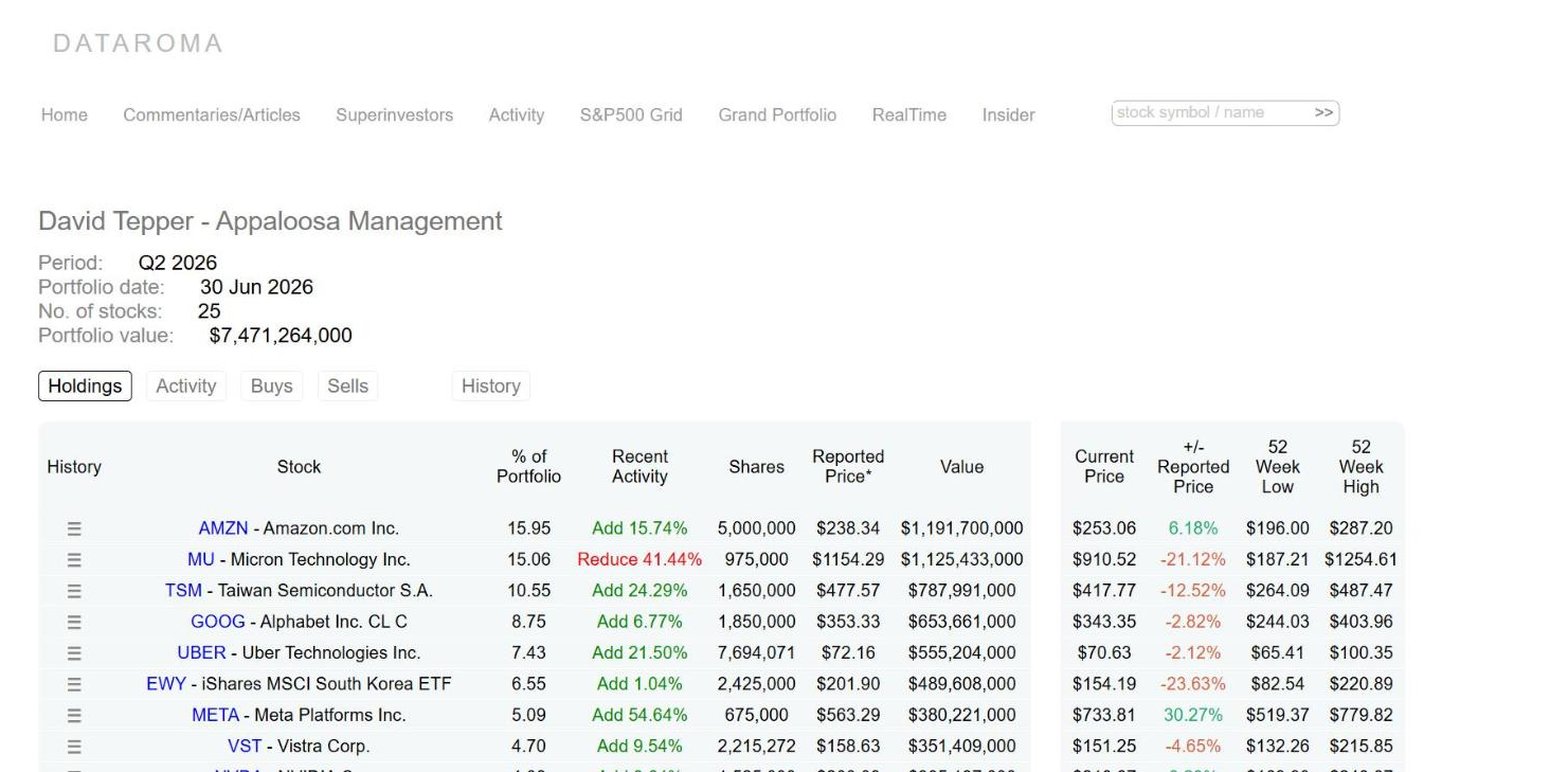
Dataroma's strength is curation. Its stock pages show how many of the 83 own a company and who added or trimmed it; Amazon sat in 34 of their portfolios for the June 2026 quarter. Its combined Grand Portfolio turns that into a quick read of where respected money is concentrated.
Where it falls short: a fund outside the 83 is not on Dataroma, and its Appaloosa portfolio counts 25 stocks and $7.47 billion, leaving out the 2 put positions. There is no export or API.
HedgeFollow
HedgeFollow covers more than 10,000 institutions and adds its own figures on top, such as top buys and sells, turnover and a fund rating for each manager, along with insider and congressional trades.
- Best for broad fund tracking on a budget.
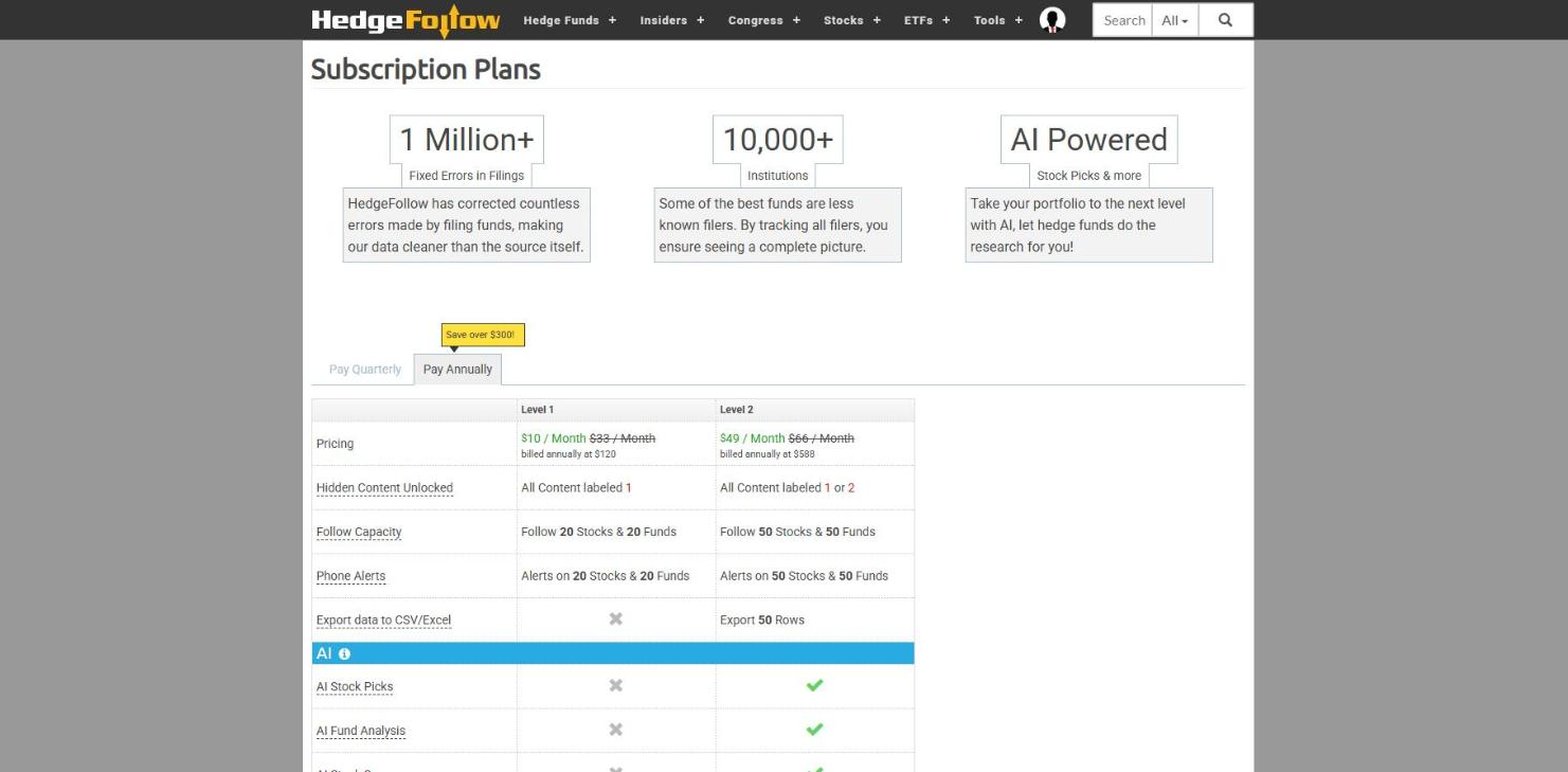
- Level 1 from $10 a month, billed annually: follow 20 funds and 20 stocks, with phone alerts.
- Level 2 from $49 a month, with CSV export and AI stock picks.
- Stock pages listing hedge fund holders and their latest activity.
HedgeFollow works from both directions: a fund page shows its top buys, sells and turnover, and a stock page lists its largest hedge fund shareholders. Lists such as largest hedge fund buys and double downs surface the quarter's biggest moves across all funds.
Where it falls short: the $10 price was a sale price on the day it was read, with the regular Level 1 price shown at $33 a month. Some content on the site is labelled for Level 1 or Level 2 and stays hidden until you subscribe, and we found no API.
HoldingsIntel
HoldingsIntel tracks fewer funds and scores them harder. It follows 563 funds that, by its own count, control about 89% of US 13F-reported capital, and layers its own measures on their filings.
- Best for scored signals on the largest funds.
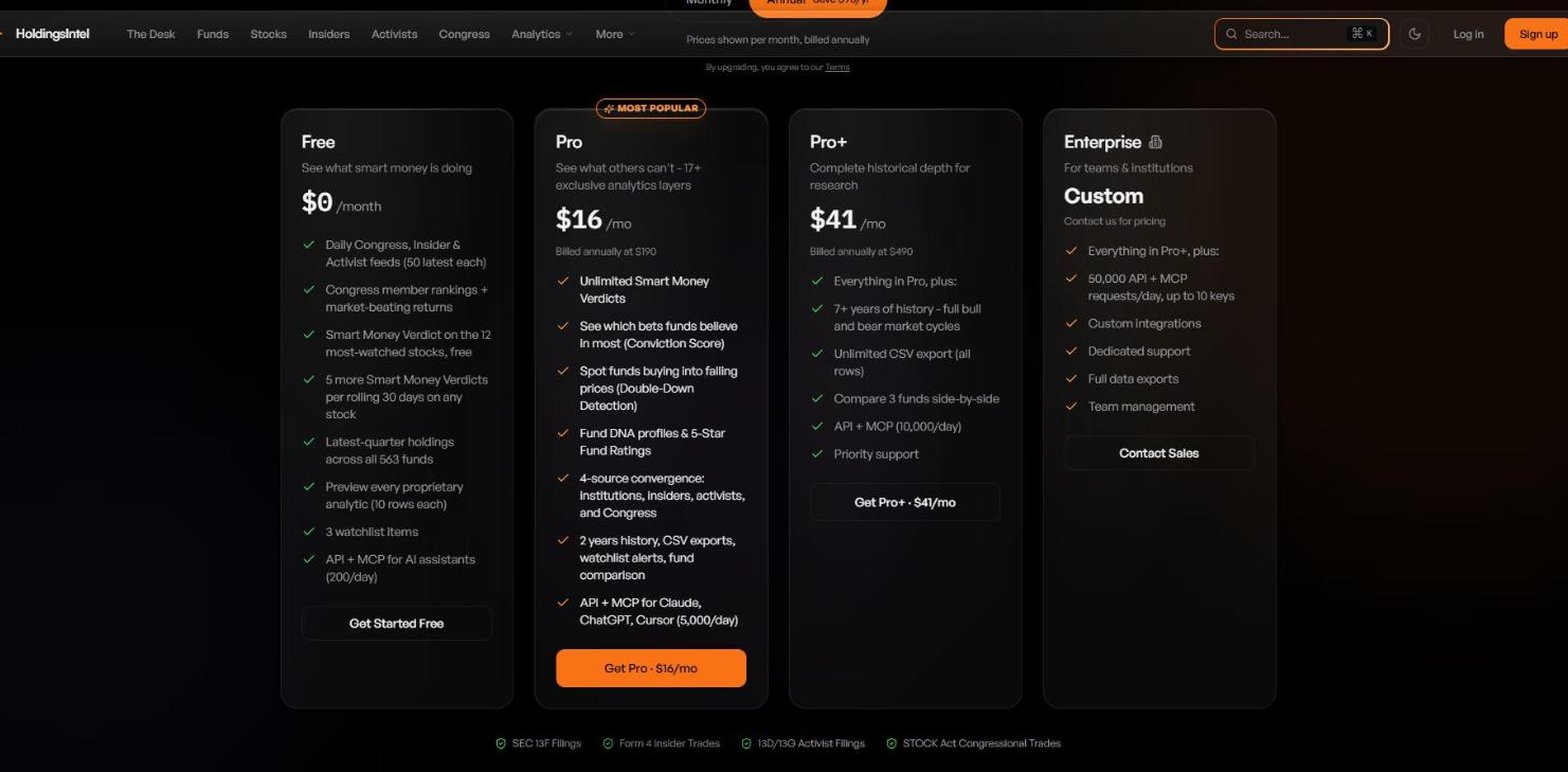
- $0 plan with the latest quarter for 563 funds, and API and MCP access.
- Pro from $16 a month, with Conviction Score, double-down detection, 2 years of history and CSV export.
- Stock pages with holders, buyers and sellers.
HoldingsIntel combines 4 public sources, 13F, Form 4, 13D/13G activist filings and congressional trades, and looks for stocks where several of them point the same way. Its AMZN page, for example, counted 460 holders for the June 2026 quarter, with 255 buying and 199 selling.
Where it falls short: smaller filers are left out in favour of the managers that hold most of the money, and history beyond 2 years needs Pro+, at $41 a month.
Stockcircle
Stockcircle puts each tracked investor's portfolio, one-year performance and recent trades on one page, from Warren Buffett and Li Lu to BlackRock and Citadel, with congressional and insider trades alongside.
- Best for guru portfolios with trade alerts.
- Investor portfolios and performance to browse without paying.
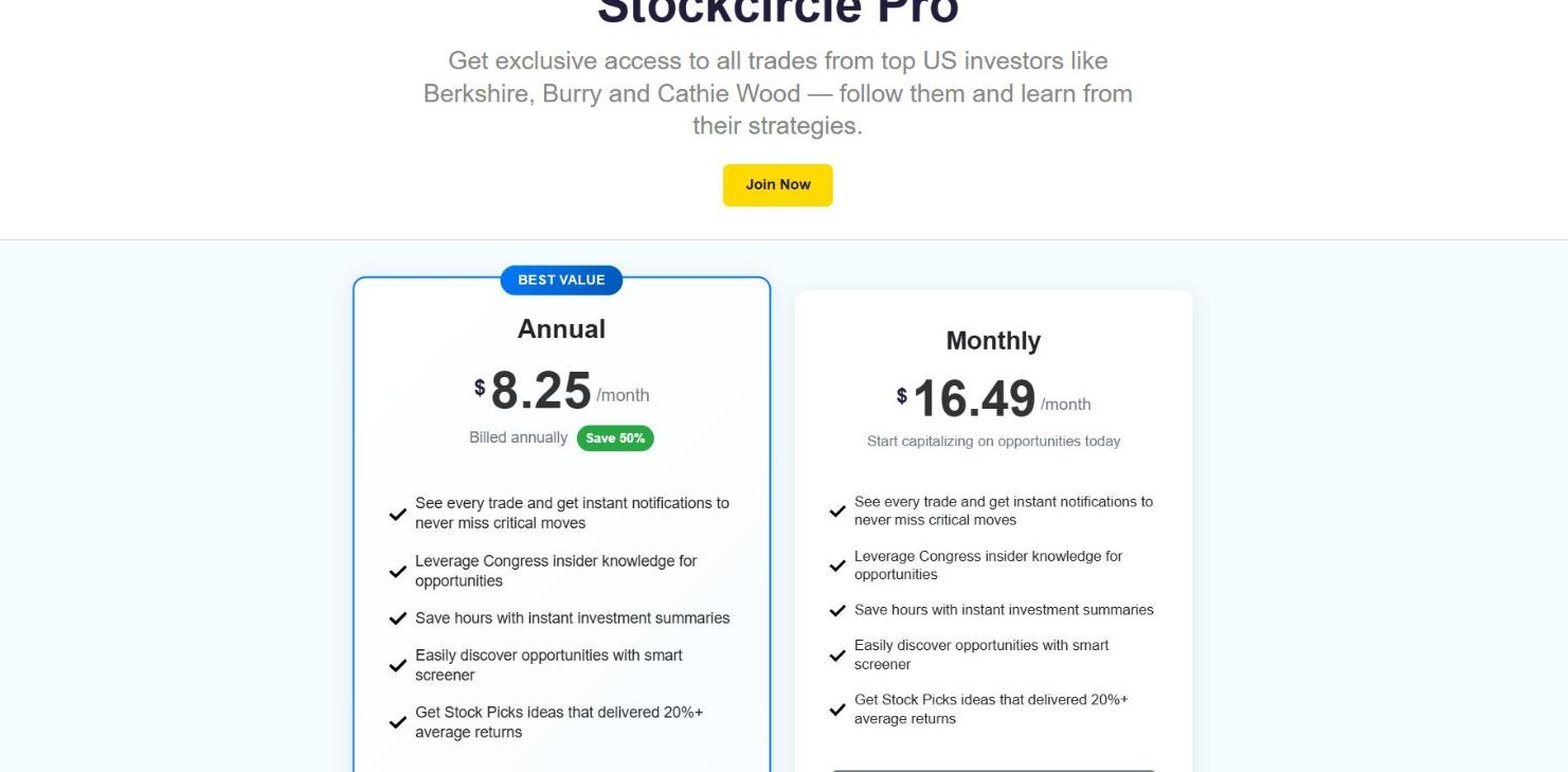
- Pro from $8.25 a month, billed annually at $99, with every trade and instant notifications.
- Stock pages showing which tracked investors hold a company.
Stockcircle is the friendliest way to follow a handful of named investors. Without Pro, its own page says, you get one monthly recap email rather than instant alerts.
Where it falls short: it does not publish how many investors it follows, and its holdings come from a licensed provider, Financial Modeling Prep, rather than its own reading of the filings. We found no export or API.
TIKR
TIKR is a research terminal for individual investors in which fund holdings are one module among financials, estimates, transcripts and a screener. How many funds you can follow is set by your plan.
- Best for fund holdings inside a research terminal.
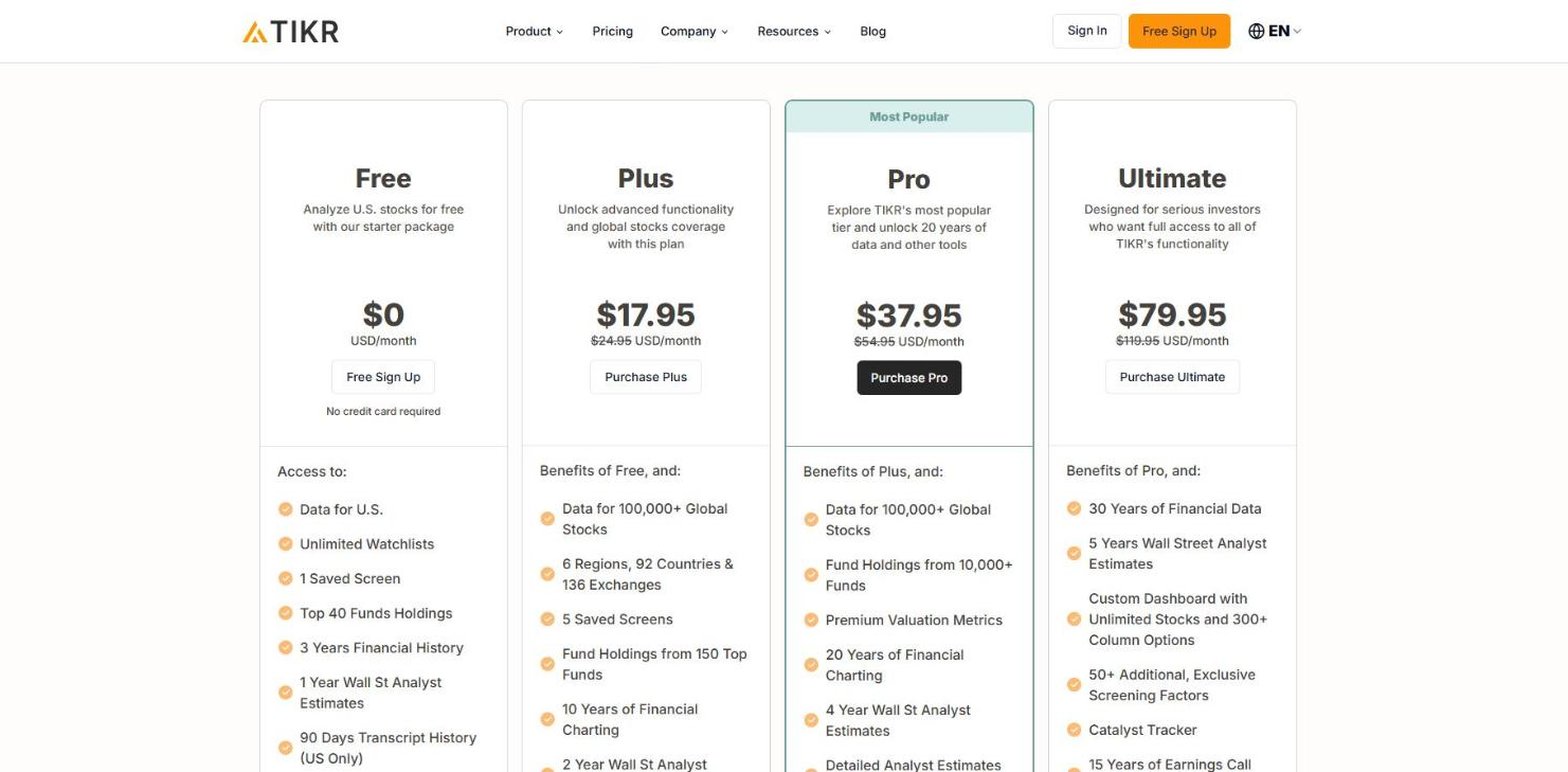
- $0 plan with the top 40 funds' holdings.
- Plus from $17.95 a month, with 150 top funds and global stocks.
- Pro from $37.95 a month, with 10,000+ funds.
TIKR suits an investor who wants to see a fund's holding and then open the company's financials and transcripts without changing site. Its blog describes the holdings view as showing the shares held and the change from the last filing.
Where it falls short: the famous names are in the free 40, but tracking a smaller manager means Pro. The pricing page lists no insider-trading view, and we found no export or API.
WhaleWisdom
WhaleWisdom launched in 2008 and collects 13F, 13D/G and Form 3 and 4 filings itself. It has built more analysis on 13F data than anyone else here: a WhaleScore for managers, a backtester, a 13F heat map, a 13F stock screener and an Excel add-in.
- Best for deep 13F history and backtesting.
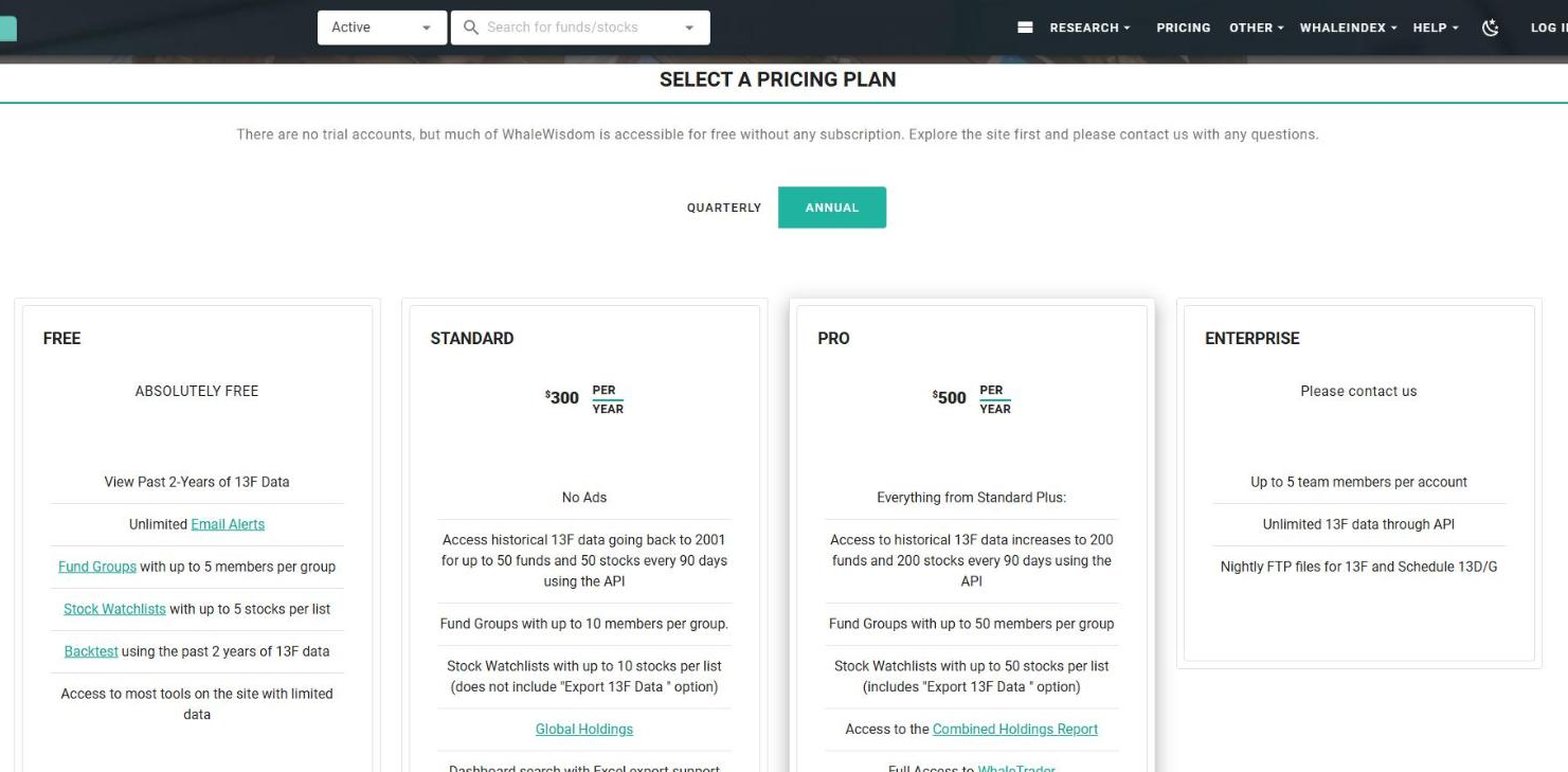
- $0 plan with 2 years of 13F data and unlimited email alerts.
- Standard from $300 a year, or $90 a quarter, with history to 2001 and API access for 50 funds and 50 stocks per 90 days.
- Pro from $500 a year, with the Combined Holdings Report and all backtester features.
- Stock pages with every 13F filer and the change from the prior quarter.
Fund pages open with the quarter's top buys and sells and a holdings summary. For Appaloosa's June 2026 filing it shows the full $7.73 billion and notes that put positions are valued as if exercised, the kind of disclosure that makes 13F totals comparable.
Where it falls short: there is no monthly plan, so the cheapest paid access is a quarter at a time, and we found no MCP server.
Business Quant
Business Quant is ours. Ownership is a tab on every stock page, so the 13F view starts from the company: who holds it, who added, who cut, and how that compares with the insiders' own trades and the company's numbers.
- Best for every 13F holder of a stock and its change, beside insider trades and financials, with export and API access.
- Free to use, with every 13F holder on about 4,700 stocks, no card.
- Pro from $29 a month, full history, export and API access.
List of features
- Institutional ownership: every 13F holder with shares, % of outstanding, value and change
- Institutions that increased, reduced or held, and net shares added
- Ownership history charts over 5 years, 10 years or the full record
- A fund's whole portfolio by SEC CIK, through the API and the MCP server
- Insider trades from Form 4, on about 5,200 stocks
- 18 million+ SEC filings since 1993
- Financial statements, segment financials and KPI data
- Analyst estimates
- Stock screener with more than 700 metrics
- Economic data
- CSV and XLSX download
Open the institutional ownership tab for GameStop and the June 2026 quarter reads as a story rather than a list. 376 institutions held 35.53% of the shares, up 0.90 percentage points; 175 added, 112 reduced and 89 held still. All 378 holder rows carry their change: Norges Bank opened a 5.2 million share position, Susquehanna added 1.38 million, Renaissance Technologies added 121,745, and Marshall Wace cut 1.92 million, 39.75% of its stake.
To follow one fund instead, the API and the MCP server look up a manager by its SEC CIK and return every stock position it reported, quarter by quarter, with the change in shares, and both are free to use. The figure above is exactly that: Appaloosa's June 2026 quarter, asked for in plain English through Claude, with every value matching the filing on EDGAR.
Hedge fund trackers feature by feature
| Platform | All 13F filers |
Holders by stock |
Insider trades too |
Spreadsheet export |
API access |
MCP server |
Plans from |
|---|---|---|---|---|---|---|---|
| Business Quant | ✓ | ✓ | ✓ | ✓ | ✓ | ✓ | $29/mo |
| HoldingsIntel | ✗ | ✓ | ✓ | ✓ | ✓ | ✓ | $16/mo |
| WhaleWisdom | ✓ | ✓ | ✓ | ✓ | ✓ | ✗ | $300/yr |
| HedgeFollow | ✓ | ✓ | ✓ | ✓ | ✗ | ✗ | $10/mo |
| 13F.info | ✓ | ✓ | ✗ | ✗ | ✗ | ✗ | $0 |
| Dataroma | ✗ | ✓ | ✓ | ✗ | ✗ | ✗ | $0 |
| Stockcircle | ✗ | ✓ | ✓ | ✗ | ✗ | ✗ | $8.25/mo |
| TIKR | ✓ | ✓ | ✗ | ✗ | ✗ | ✗ | $17.95/mo |
Sorted by ticks, ties broken alphabetically. A tick means the platform's own pricing, plan or product pages document the feature on a self-serve plan, or its pages showed it when we tested them; a cross means we found no such documentation. "All 13F filers" means the platform covers every 13F filer, or 10,000 or more of them, rather than a curated list; TIKR's tick is for its Pro plan. "Holders by stock" means a page listing the institutions that hold a given stock. "Insider trades too" means Form 4 insider trades are on the same site. "Spreadsheet export" means downloading holdings to a file. "API access" and "MCP server" mean a self-serve API and an AI-assistant connector.
Business Quant is the only tracker here that ticks every column. HoldingsIntel and WhaleWisdom come next with 5 each: HoldingsIntel has an MCP server but a curated fund list, and WhaleWisdom covers every filer but has no MCP server. HedgeFollow follows with 4. Dataroma and Stockcircle cover fewer funds on purpose, and 13F.info shows filings without interpretation because that is what it is for. A cross shows what a product was built for, not how good it is.
Which hedge fund tracker is right for you?
- You want 2 quarters of a filing side by side, exactly as filed: 13F.info.
- You follow famous value investors: Dataroma.
- You want broad coverage and alerts on a budget: HedgeFollow.
- You want scored signals across 13F, insider, activist and Congress filings: HoldingsIntel.
- You want instant alerts when a named investor trades: Stockcircle.
- You already research in a terminal: TIKR.
- You want 13F history back to 2001 and a backtester: WhaleWisdom.
- You start from a stock and want every holder's change beside insider trades and financials, with export and an API: Business Quant.
For pulling 13F data into your own code, our institutional ownership API comparison covers the developer side, and for how filings are structured, start with the SEC filings guides.
Where I would follow a fund
If all you want is a famous manager's latest portfolio once a quarter, almost any free tool will show it. I would still do the real work on Business Quant.
A fund adding to a stock tells you little on its own. Whether 175 other institutions added too, whether the company's insiders were selling at the same time, and whether the latest quarter's numbers support the move tells you a lot. Business Quant puts all 3 on the same stock page, with every 13F holder and its change, Form 4 trades on the next tab, and the financial statements. When you want to start from the fund instead, the API and MCP server return its whole quarter by CIK, as the Appaloosa table above shows. It is free to use, and Pro, with full history, export and API access, is from $29 a month.
A 10-minute test: pick a fund you follow and its largest new position from the last filing. Open that stock's ownership tab and count how many other institutions added and how many cut in the same quarter, then open the insider tab for the same months. If the fund is buying while most holders and the executives are selling, you have learned more than the headline told you.
How this comparison was made
To make the list, a website had to let an individual see hedge fund or other institutional 13F positions and how they changed from the prior quarter, by fund, by stock or both, either at no cost or at a self-serve price published on the vendor's own site. Raw filing archives that compute no changes, and alert apps with no 13F view, were not included. 8 trackers met that bar.
Every price, plan limit and coverage figure was read on the vendor's own pricing, plan or product pages on 15 October 2026 and screenshotted there, and stock pages and plan details were checked again on 16 October. Prices are each platform's lowest advertised monthly price in US dollars on 15 October 2026; WhaleWisdom advertises quarterly and yearly prices only. The Appaloosa figures were checked against the 13F information table on SEC EDGAR, and our illustration was pulled live through our MCP server on the same day.
The list, the summary table and the reviews run alphabetically, with Business Quant last, and the feature table is sorted by the number of ticks, with ties broken alphabetically. We make Business Quant, one of the 8 products compared here.
Image credits. Header photograph by Steve Wrzeszczynski on Unsplash, used under the Unsplash License. Vendor screenshots were captured on 15 October 2026 from each provider's own pricing, plan or holdings pages and are reproduced for comparison. The Appaloosa illustration is our own, built from our 13F data.
Frequently asked questions
What is the best hedge fund tracker?
It depends on which side you start from. If you start from a stock and want to know which funds bought or sold it, Business Quant shows every 13F holder of a US-listed stock with its quarter-over-quarter change, free to use, and its API and MCP server return any single fund's positions. If you start from a famous manager, Dataroma follows 83 superinvestors at no cost, WhaleWisdom has 13F history back to 2001 from $300 a year, and HedgeFollow covers 10,000+ institutions from $10 a month.
Is there a free hedge fund tracker?
Yes, several. Dataroma and 13F.info are free with no paid plan at all. Business Quant is free to use: the institutional ownership tab on each stock lists every 13F holder and how its position changed, and its API and MCP server are free to use too. WhaleWisdom shows the past 2 years of 13F data free, TIKR covers the top 40 funds on its $0 plan, HoldingsIntel shows the latest quarter for 563 funds, and HedgeFollow and Stockcircle can be browsed before you pay.
How do I track what hedge funds are buying?
Read their quarterly 13F filings, which list long positions in US-listed stocks. A tracker saves you comparing 2 filings by hand: it shows which positions are new, which grew and which were cut. Look up the fund to see its whole portfolio change, or look up a stock to see which funds moved into or out of it. Business Quant does the second on every covered stock page, for example GameStop, where 175 institutions added shares in the June 2026 quarter and 112 reduced.
Are 13F filings delayed?
Yes. A manager has 45 days after each calendar quarter ends to file, so a portfolio dated 30 June can appear as late as 14 August. Appaloosa's June 2026 13F was filed on 14 August 2026, the last day. By the time any tracker shows it, the positions are at least 6 weeks old and may already have changed.
Can I copy a hedge fund's portfolio from its 13F?
Only approximately. A 13F shows long positions in US-listed stocks and some options at quarter end, but not short sales, most non-US holdings, cash or what happened during the 45 days before filing. The same filing can also be totalled differently: Appaloosa's June 2026 13F is $7.73B including 2 put positions and an ETF, $7.47B without the puts, and $6.98B in stocks alone. Treat a 13F as a list of ideas with a date on it, not a live portfolio.
Which funds have to file a 13F?
Institutional investment managers with discretion over $100 million or more in 13F securities, which are mostly US-listed stocks plus some options. That includes hedge funds, mutual fund companies, banks, insurers, pension managers and large family offices. It is why a stock's 13F holder list can run to hundreds of names: GameStop had 378 holder rows for the June 2026 quarter on Business Quant.